
Shitta-Bey Mosque in Lagos, Nigeria
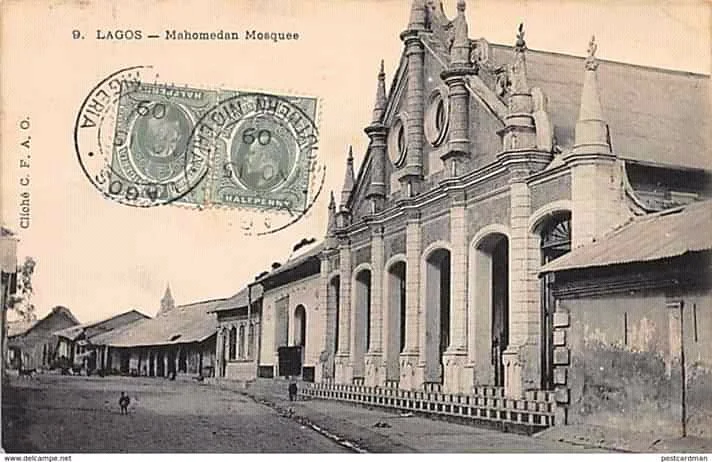
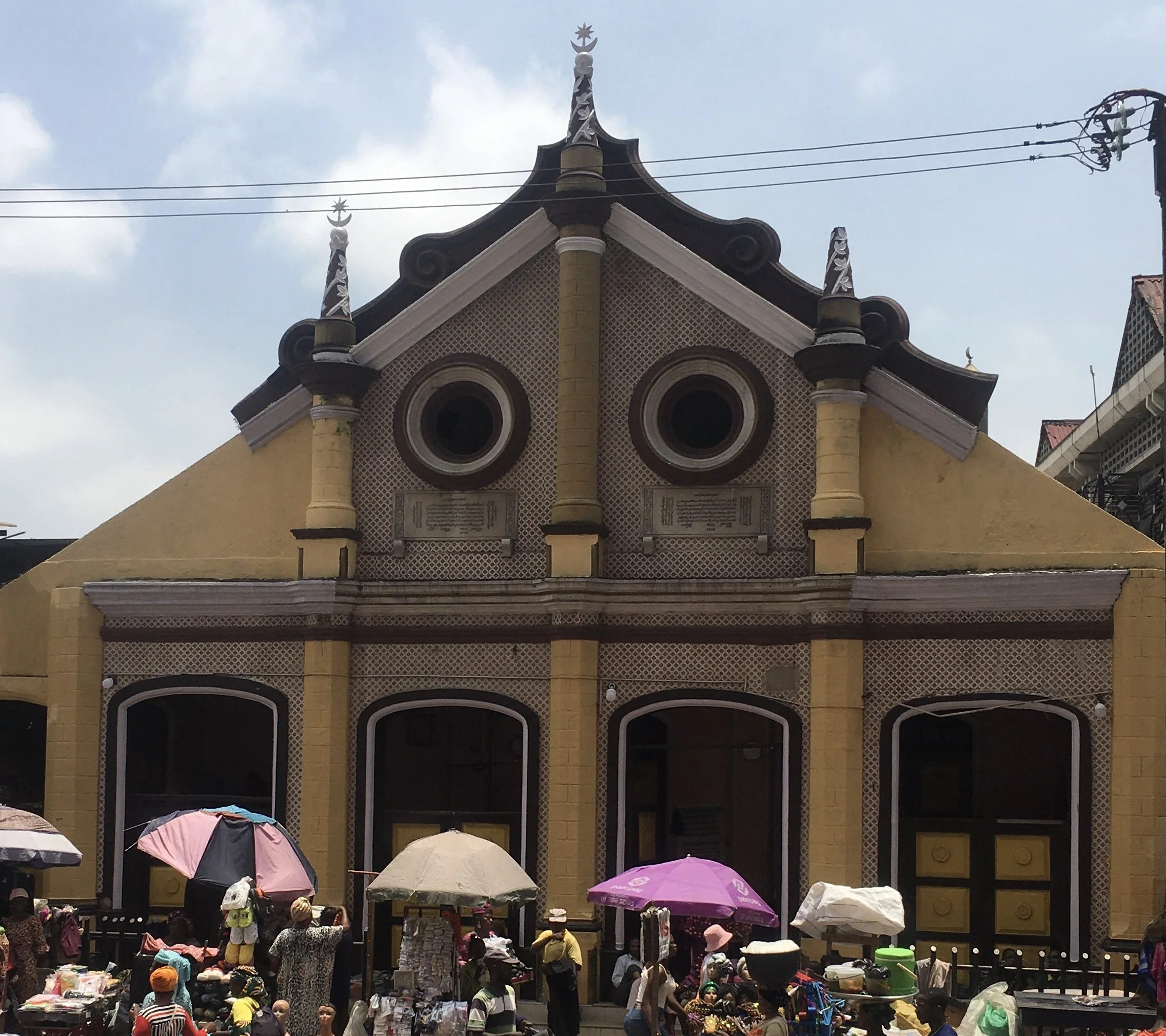
On Martins Street, Lagos Island, a building stops most passers-by before they realize it is a mosque. Its facade carries a triangular pediment, decorative balustrades, floral pinnacles, and curved lintels drawn from 19th-century Brazilian colonial architecture. No dome. No pointed arch portal. The single tower reads more like a campanile than a minaret. This is the Shitta-Bey Mosque, built 1891-1894 at a cost of £3,000 by a Yoruba Muslim merchant who commissioned an Afro-Brazilian architect to design the most visible Islamic building colonial Lagos had ever seen. Designated a Nigerian national monument in 2013, it remains one of the only mosques in the world that belongs architecturally to the Afro-Brazilian tradition, a building type born from forced migration, skilled return, and the determination of West African Muslims to claim space in a colonial city.
Who Built the Shitta-Bey Mosque and Why?
Mohammed Shitta (c.1824-1895) was born in Sierra Leone to Yoruba parents who had been liberated from slavery. His father served as imam of the Muslim community in Badagry before his death in 1847. Mohammed relocated to Lagos around 1861, built wealth through trade in palm oil and kola nuts across the Niger Delta, and returned to Lagos Island permanently in 1885 as one of the city's most prominent Muslim merchants. He had already contributed financially to the Lagos Central Mosque in 1873. The Martins Street mosque was his major act of patronage: a purpose-built congregational mosque for the growing Yoruba Muslim community in a Lagos increasingly defined by British colonial authority.
The mosque's commissioning was both religious and political. Lagos in the 1880s and 1890s was a British colonial city where Christianity and European-backed civic institutions dominated public life. Building a large, well-finished mosque on a main street asserted that the Muslim community belonged to this city on its own terms. Shitta hired architect João Baptista da Costa, an Afro-Brazilian craftsman working in Lagos, to design the structure. The Nigerian builder Sanusi Aka completed construction in 1892, with the formal inauguration following on July 4, 1894.
That inauguration ceremony concentrated remarkable symbolic weight. The British colonial governor Sir Gilbert Carter presided. Oba Oyekan I of Lagos attended. Edward Wilmot Blyden, the pan-African intellectual, was present. Abdullah Quilliam, president of the Liverpool Muslim Association, came as the representative of Ottoman Sultan Abdülhamid II and delivered a letter from the Sultan to the Lagos Muslim community. He also conferred on Mohammed Shitta the Ottoman Order of Medjidie and the honorific title "Bey," making him Seriki Musulumi (head of Lagos Muslims) recognized by an Islamic caliphate. Mohammed Shitta-Bey died the following year in 1895, having opened the mosque that bore his title.
What Makes the Shitta-Bey Mosque's Architecture Distinctive?
The building follows what scholars call the Afro-Brazilian church-mosque type: a West African mosque designed using the architectural vocabulary of colonial Brazilian churches. This is not a contradiction or a compromise. It was a deliberate, confident choice by a Muslim patron and an Afro-Brazilian craftsman who knew exactly what they were doing and why.
The facade, the building's primary architectural statement, features six bays across the ground floor with curved lintels following a classical model but executed with a local Yoruba-Brazilian character. A triangular pediment crowns the composition, bordered by curvilinear decorative elements. Semi-detached pinnacles with floral motifs rise above the parapet, and balustrades articulate the upper level. The ornamentation relies on stucco work rather than the glazed ceramic tiles (azulejos) more commonly associated with Brazilian colonial buildings in Lagos; this reflects the specifically Afro-Brazilian workshop tradition, which adapted Portuguese-derived forms using locally produced rendered surfaces.
The mosque plan is square, with the prayer hall organized on an internal grid that includes galleries. Vaulted ceilings cover the prayer space, and the brick facade is divided by stone pillars. A single tower rises above the entrance rather than a pair of minarets, a feature consistent with Yoruba Afro-Brazilian mosques that typically preferred a centered tower over the double-minaret arrangements found in North Africa or the Ottoman tradition. The qibla wall is oriented toward Mecca on the interior, maintaining Islamic spatial requirements within a building whose exterior speaks a different architectural language entirely.
Construction materials document the Atlantic connections the mosque embodies: concrete, granite, and marble in a city where earlier mosques had been built with mud and bamboo.
How Did the Afro-Brazilian Architectural Tradition Reach Lagos?
The Afro-Brazilian style in Lagos originated with the Aguda, Yoruba people who had been enslaved and taken to Brazil, primarily to Bahia. The Male Revolt of 1835, a major uprising by Muslim slaves in Bahia, served as a turning point. Bahian authorities deported many slaves back to West Africa in its aftermath, and return migration accelerated as slavery was abolished in Cuba (1886) and Brazil (1888). By 1887, over 3,000 returnees had settled in Lagos, concentrating in the district now called Popo Aguda (the Brazilian Quarter).
The returning Aguda brought construction expertise acquired in Bahia, where they had formed the bulk of skilled labor. Carpentry, bricklaying, and masonry were primary trades. Back in Lagos, these craftspeople built for themselves and for wealthy Yoruba patrons who commissioned the Brazilian style as a mark of cosmopolitan status. The style spread from its originators to a broader Lagos building culture throughout the late 19th century. João Baptista da Costa, the Shitta-Bey Mosque's architect, worked within this community of Afro-Brazilian builders whose practice shaped the architectural character of Lagos Island.
It’s important to note that Mohammed Shitta was not from the Aguda community himself. He came through the Saro (Sierra Leonean Yoruba) returnee network, not the Brazilian one. His commissioning of an Afro-Brazilian architect demonstrates how the style had become a prestige architectural language available to Lagos's Muslim elite across different diaspora communities, not limited to those with direct Brazilian connections.
How Does the Mosque's Spatial Plan Function as Civic Statement?
The Shitta-Bey Mosque operates as architecture of assertion. Its exterior faces outward, toward the street and the colonial city, announcing to anyone passing that Muslims were building permanently here. The ornate facade is the primary communicative surface. This contrasts with the spatial logic of many historic mosque types, where the exterior is often plain and interior courtyard spaces carry the architectural significance.
This difference is not accidental. The Afro-Brazilian mosque type adapted the extroversion of Brazilian colonial churches, where elaborate facades announced institutional presence to the urban public. For a Muslim community navigating a colonial city dominated by Christian institutions and British authority, an imposing, well-crafted facade served a specific social function: visibility, permanence, and civic legitimacy.
The mosque's interior accommodates congregational prayer with galleries providing additional capacity and vaulted ceilings creating a dignified enclosed space. The building holds approximately 200 worshippers, a modest capacity compared to the great congregational mosques of North Africa or Egypt, but suited to the neighborhood scale of Lagos Island and significant within the context of 19th-century Lagos, where the Muslim community had previously lacked a purpose-built mosque of this quality.
How Does Shitta-Bey Mosque Reflect West African Islamic Architecture of Its Era?
The building sits at an unusual intersection in Islamic architectural history. West African Islamic architecture in the 19th century broadly fell into two traditions: the earthen mosque tradition of the Sahel (exemplified by the Great Mosque of Djenné in Mali and the older mosques of northern Nigeria), and the hypostyle stone or brick mosques influenced by North African and Egyptian precedent. The Shitta-Bey Mosque belongs to neither. It represents a third current: the creolized Atlantic-facing architecture of coastal West African Muslim communities whose histories were shaped by the slave trade and its aftermath.
The Journal of Architectural Conservation has identified the Afro-Brazilian mosque type as a "cross-fertilization of Luso-Brazilian architectural elements with West African Islamic architectural traditions," and the Shitta-Bey Mosque is the best-documented example. Other Afro-Brazilian mosques existed in Lagos and across Yorubaland (the former Ahmadiyya Central Mosque carried a degraded version of the same decorative pinnacle motifs), but none achieved the scale, the finishing, or the documented historical significance of this building.
The mosque's relationship to Islam's Ottoman connection is also distinctive. At the 1894 inauguration, the Ottoman Sultan's representative brought formal recognition from Istanbul to a mosque in a British colonial West African city. For the Lagos Muslim community, this gesture connected their local institutions to the global ummah across a complex geography of diaspora, colonial rule, and Islamic civilization.
What Is the Mosque's Current Status and Legacy?
The Shitta-Bey Mosque remains in active use as a congregational mosque on Martins Street, Lagos Island. The Nigerian Commission for Museums and Monuments designated it a national monument in 2013, recognizing its status within Nigeria's built heritage. Conservation challenges are ongoing: urban pressures in central Lagos, material aging of the stucco ornamentation, and the general vulnerability of 19th-century masonry in a dense, humid coastal city all affect the building's fabric.
The mosque's influence on subsequent Lagos architecture is difficult to separate from the broader Afro-Brazilian style's influence on the city. The decorative approach it exemplifies, particularly the pinnacle and balustrade vocabulary, appeared in later buildings across Lagos Island into the early 20th century. As that generation of Afro-Brazilian craftspeople passed and the Lagos construction industry shifted, the style receded, making surviving examples like Shitta-Bey increasingly rare.
For scholars of Islamic architecture, the mosque complicates tidy narratives about what Islamic religious buildings look like. A mosque whose primary facade draws on Brazilian Baroque ecclesiastical architecture, built by an African craftsman with roots in Bahia, commissioned by a Sierra Leonean-Yoruba merchant in a British colony, formally recognized by the Ottoman Caliphate: this building holds the full complexity of the 19th-century Muslim world within its ornamented stucco walls.
For Muslim families tracing the history of Islam in West Africa, Shitta-Bey is evidence of how profoundly local and personal that history was. Mohammed Shitta-Bey spent £3,000, his own money, on a building his community needed. He did not live to see more than one year of its operation. The mosque is still there.
Glossary:
Aguda: Yoruba returnees from Brazil (and Cuba), also called Amaro, who settled in Lagos and other West African coastal cities from the 1830s onward after emancipation or deportation.
Azulejos: Glazed ceramic tiles used as exterior or interior cladding, characteristic of Portuguese and Brazilian colonial architecture.
Qibla: The direction of prayer toward the Kaaba in Mecca.
Saro: Yoruba people who had been liberated from slavery and settled in Sierra Leone before returning to Lagos in the 19th century; distinct community from the Aguda.
Seriki Musulumi: Yoruba term for the head or chief of the Muslim community.
