
Cambridge Central Mosque in Cambridge, England
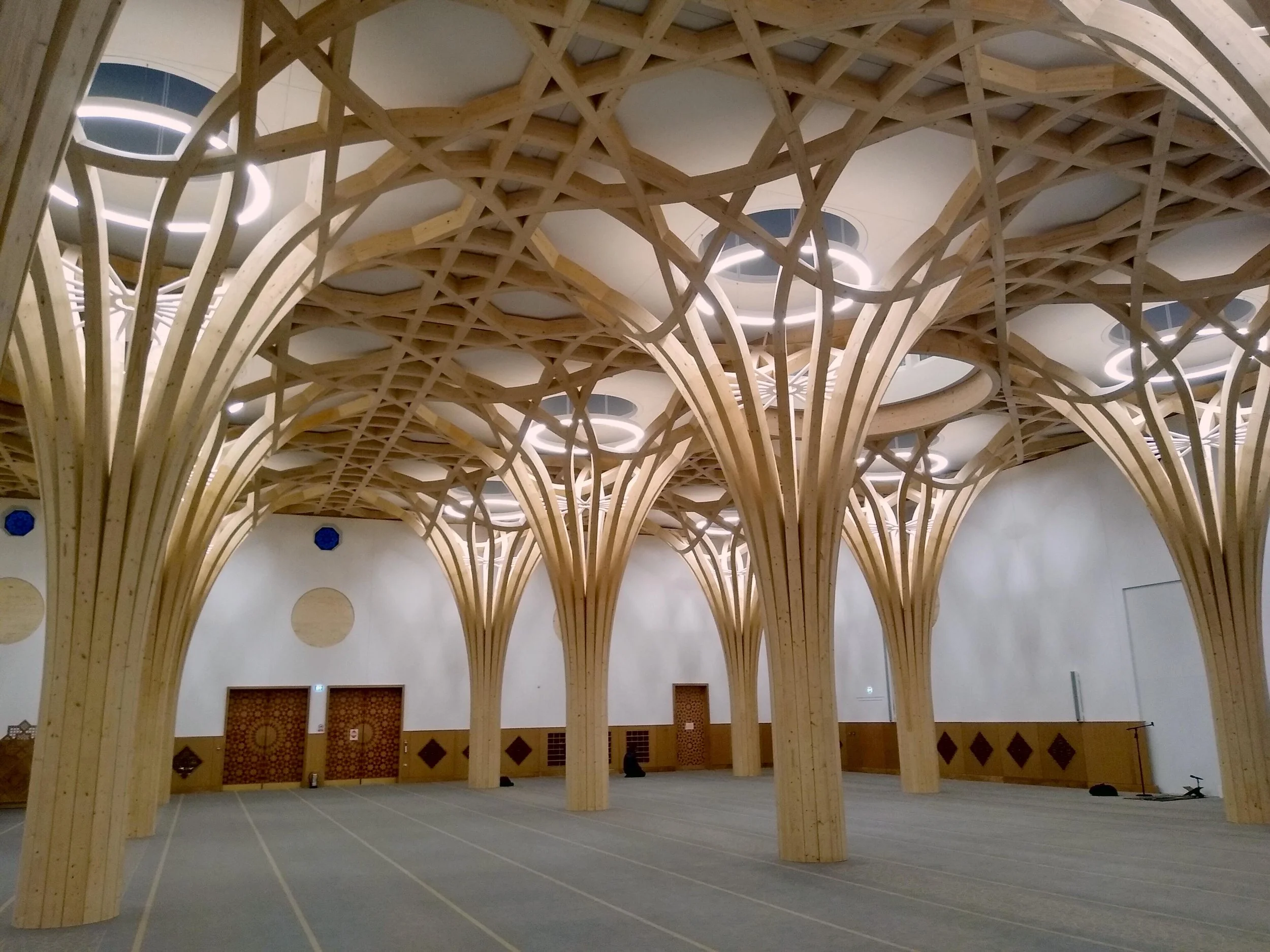
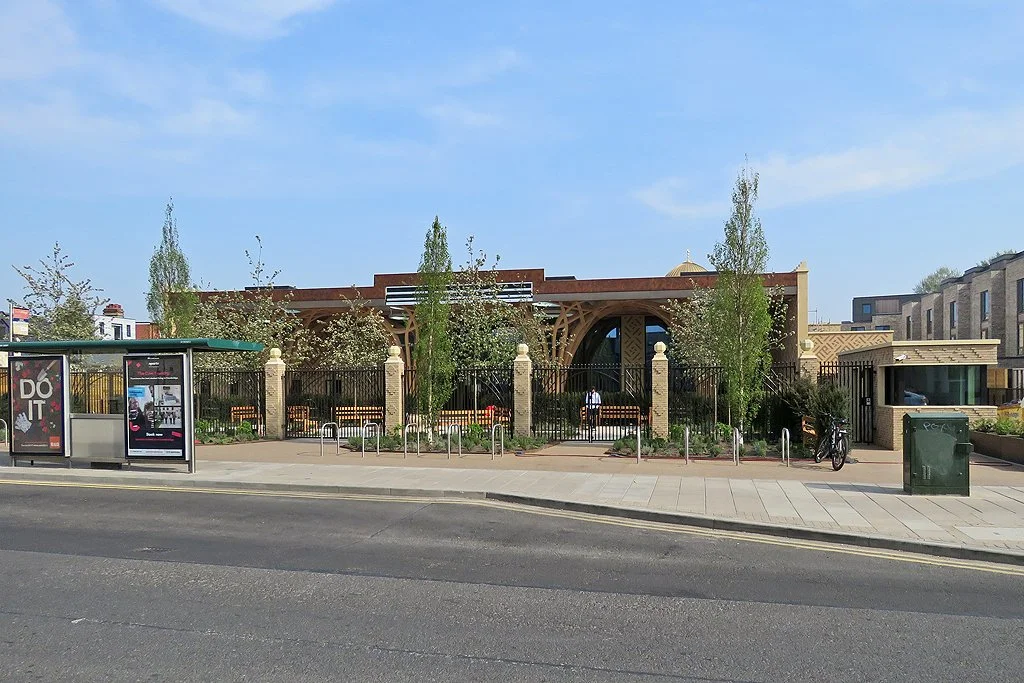
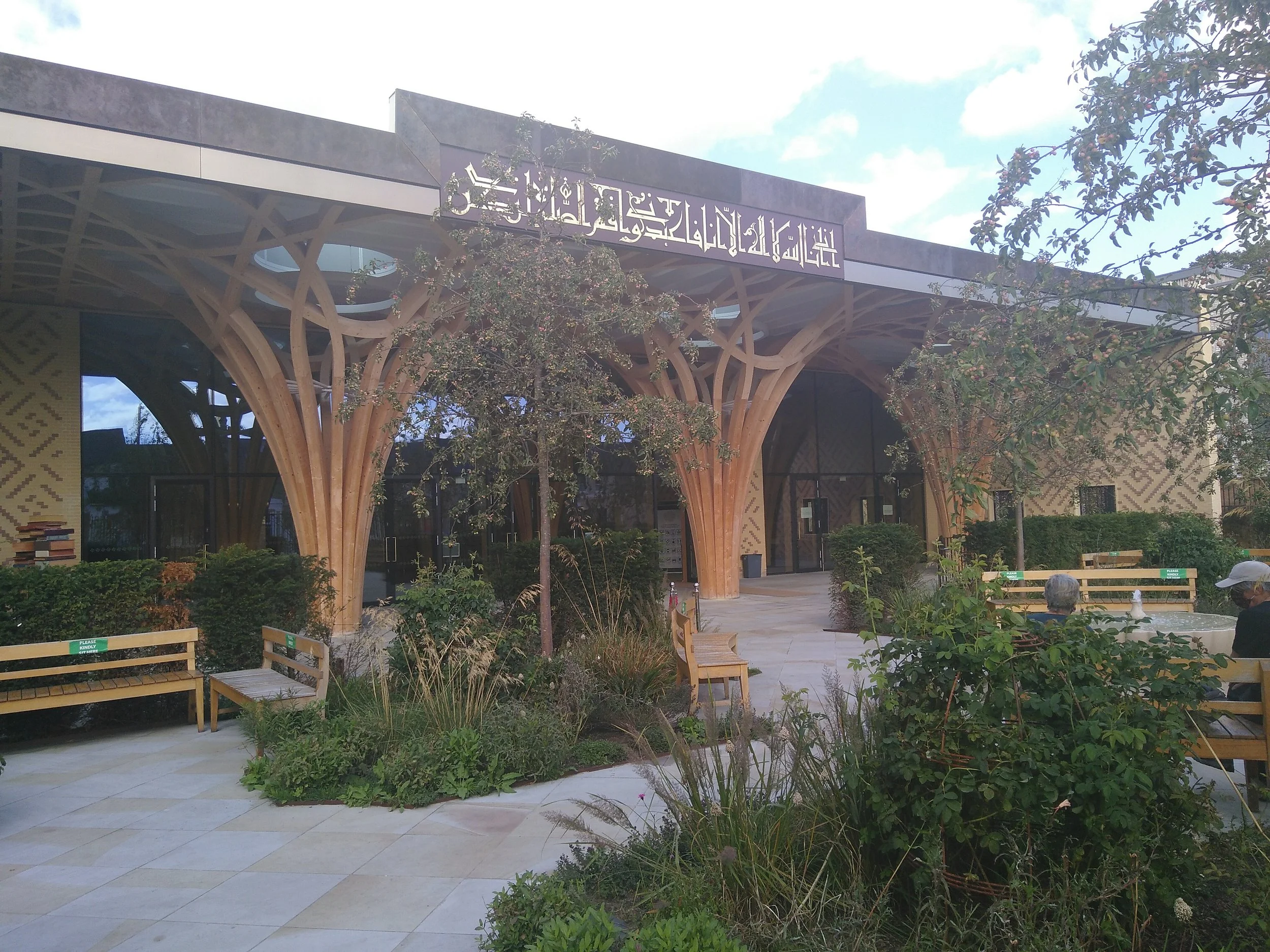
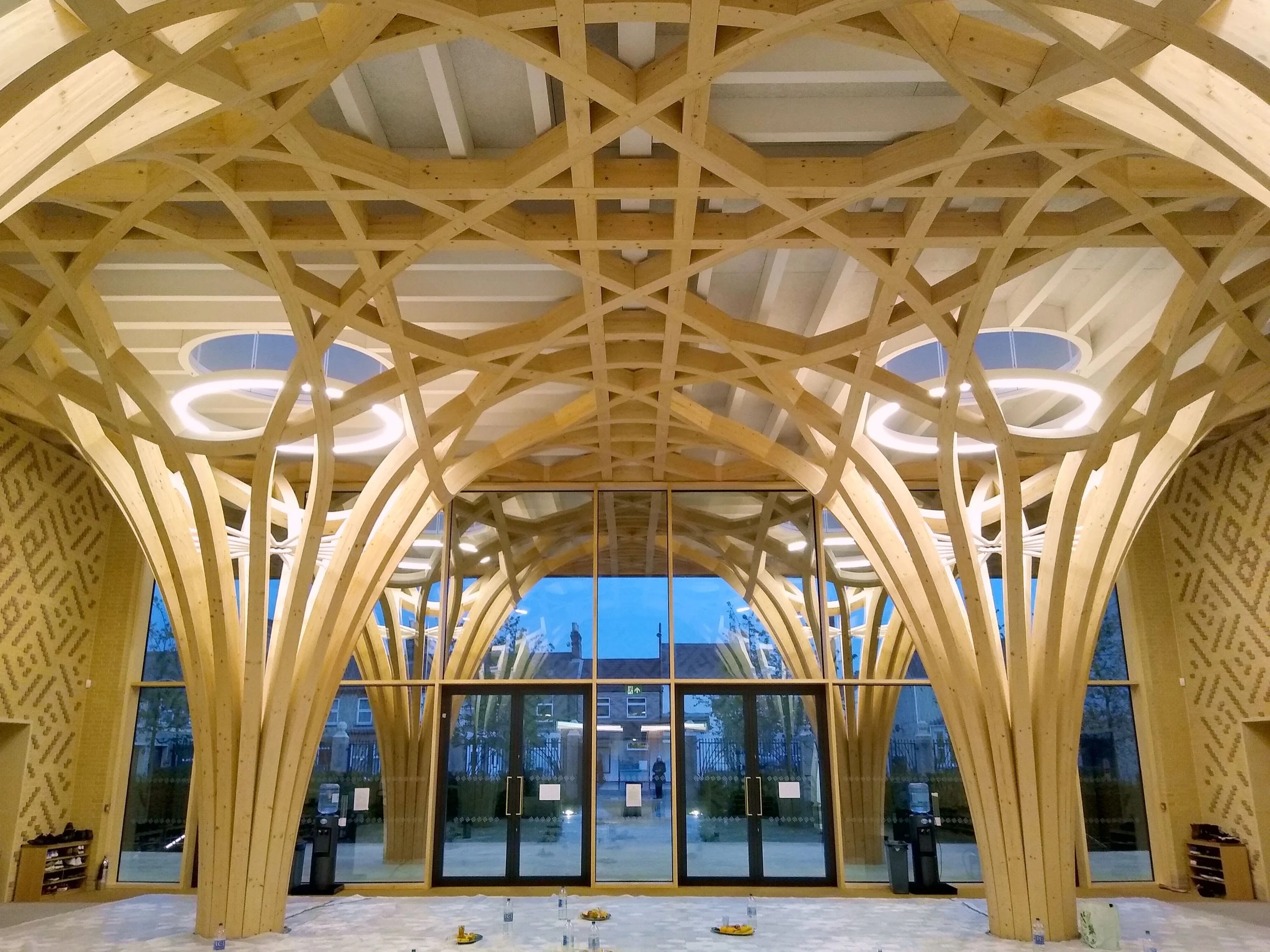
Cambridge Central Mosque opened on Mill Road in April 2019 as the city's first purpose-built mosque, and the first in Europe designed explicitly as an eco-mosque. Commissioned by the Cambridge Mosque Trust and designed by Marks Barfield Architects following a 2009 international competition, the £23 million building accommodates 1,000 worshippers in a prayer hall roofed by glulam timber columns engineered to resemble a forest canopy. The building's central design question, what does a British mosque look like in the 21st century, shaped every material decision, from locally sourced brick tiles to sustainably harvested spruce timber fabricated in Switzerland. Its answer sits on a working-class street in the Romsey area of Cambridge, a few hundred meters from one of England's most recognizable medieval spaces.
Who Built Cambridge Central Mosque and Why?
The immediate trigger for the project was practical. The existing Mawson Road mosque had been operating beyond capacity, with worshippers regularly spilling onto the street for Friday prayers. In 2007, the Muslim Academic Trust, led by Cambridge academic and Islamic scholar Tim Winter (known by the name Abdal Hakim Murad) and co-initiated by Yusuf Islam (the musician formerly known as Cat Stevens), began planning a dedicated purpose-built facility. An international design competition followed in 2009.
The brief went beyond square footage. It called for a mosque that was genuinely sustainable, meaningfully integrated into its Cambridge neighborhood, and architecturally honest about Islam's presence as part of British cultural life. Murad framed this as a continuation of mosque architecture's long tradition of adapting to the places Muslims settle, referencing buildings from Andalusia to Central Asia where local materials and climates shaped Islamic sacred space. Marks Barfield Architects, the firm behind the London Eye, won the competition with a proposal centered on the image of a mosque as a garden oasis, a concept with deep roots in Islamic spatial tradition.
Construction began in 2016 on a brownfield site previously used as a cement works, sawmill, foundry, and petrol station, and most recently occupied by a John Lewis warehouse destroyed by fire in 2009. Soil remediation was required before building could begin. The project completed in April 2019.
What Makes Cambridge Central Mosque's Architecture Distinctive?
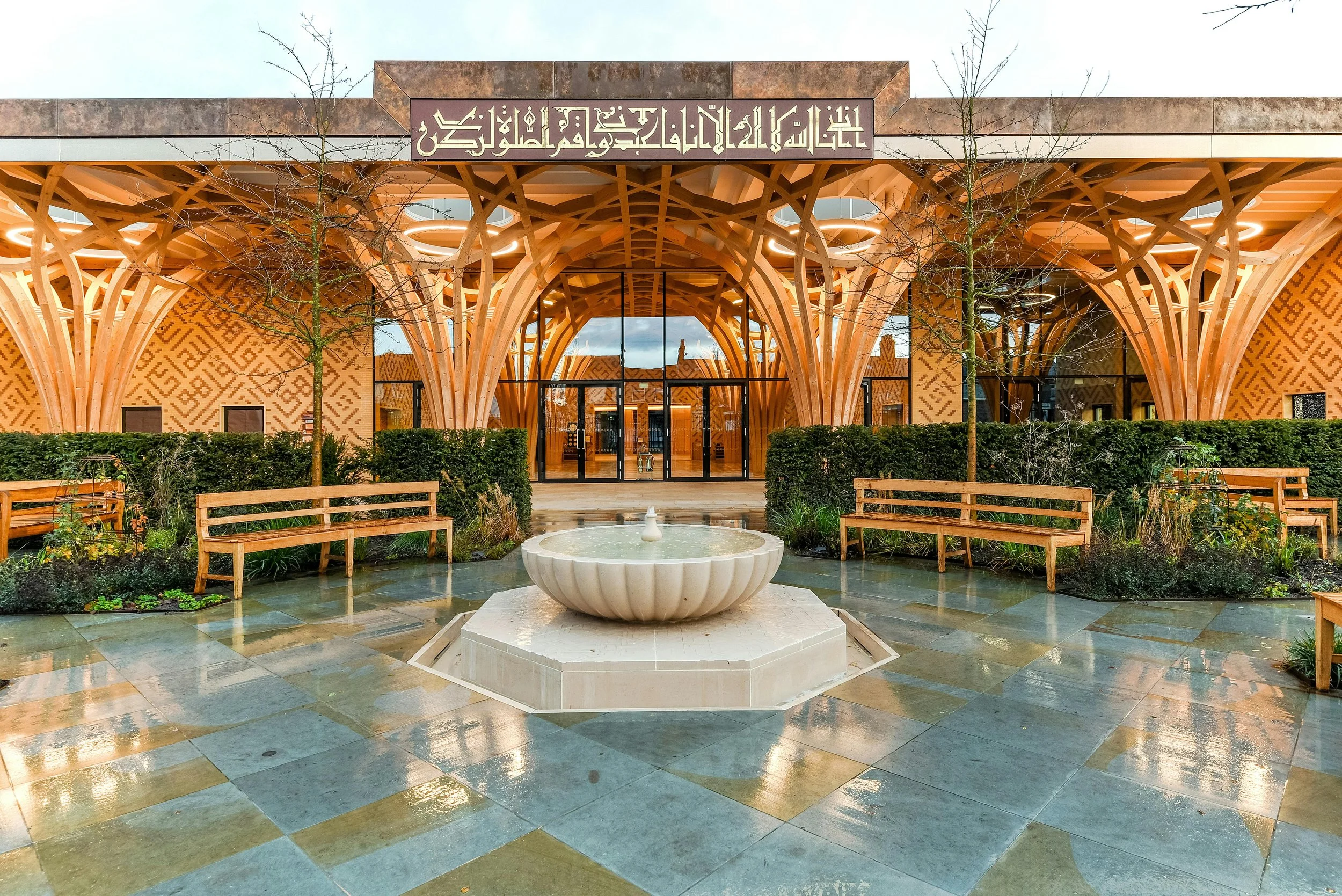
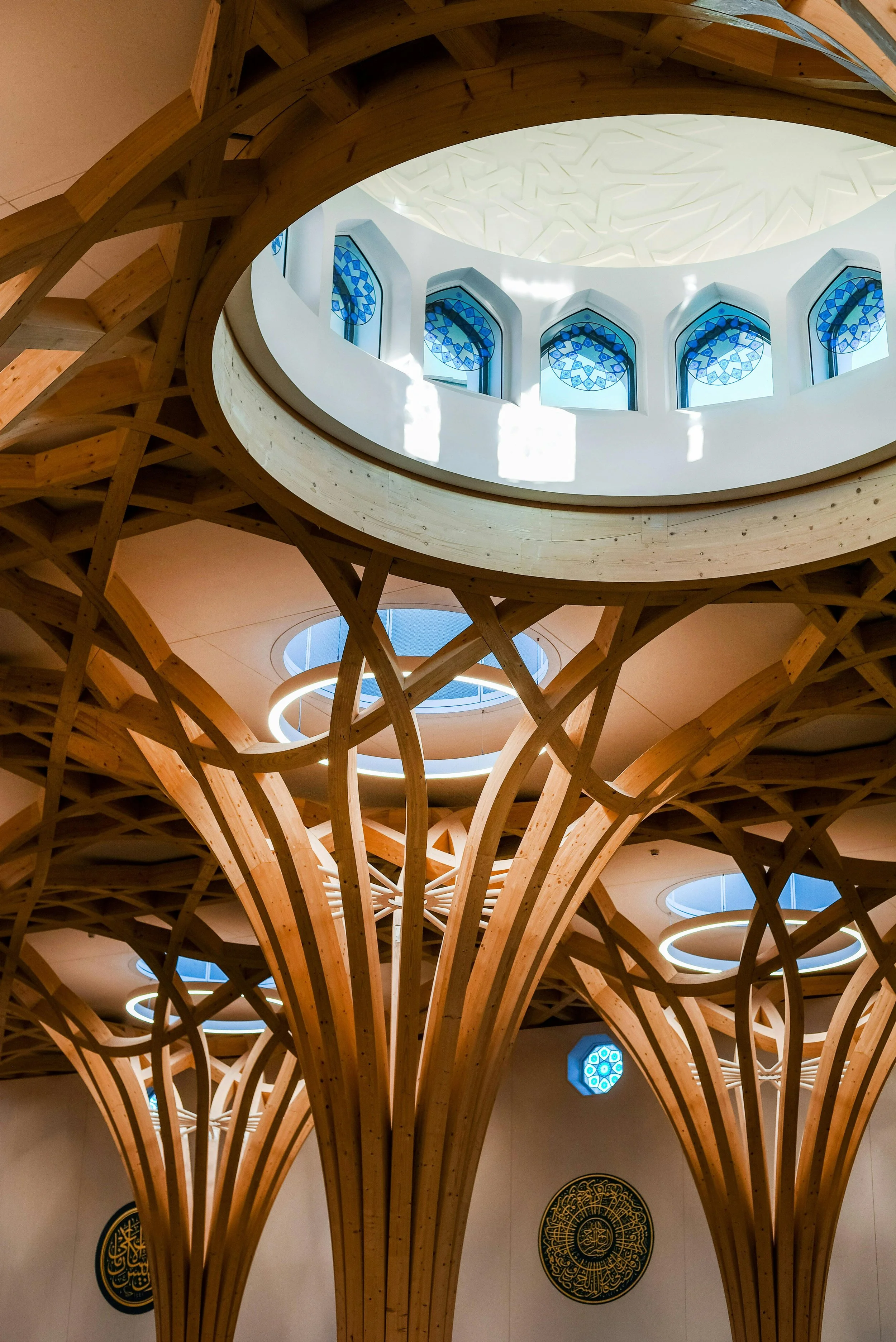
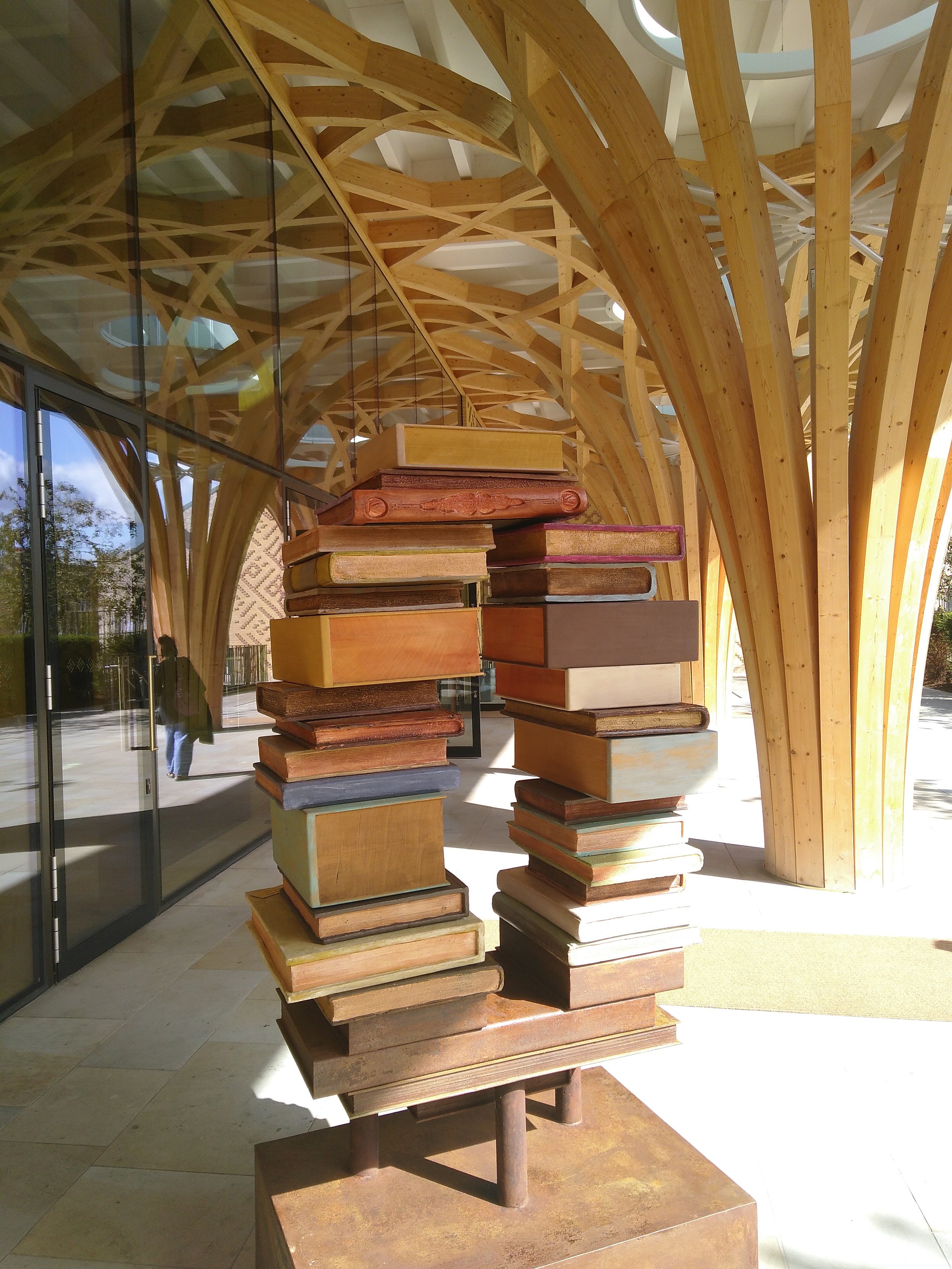
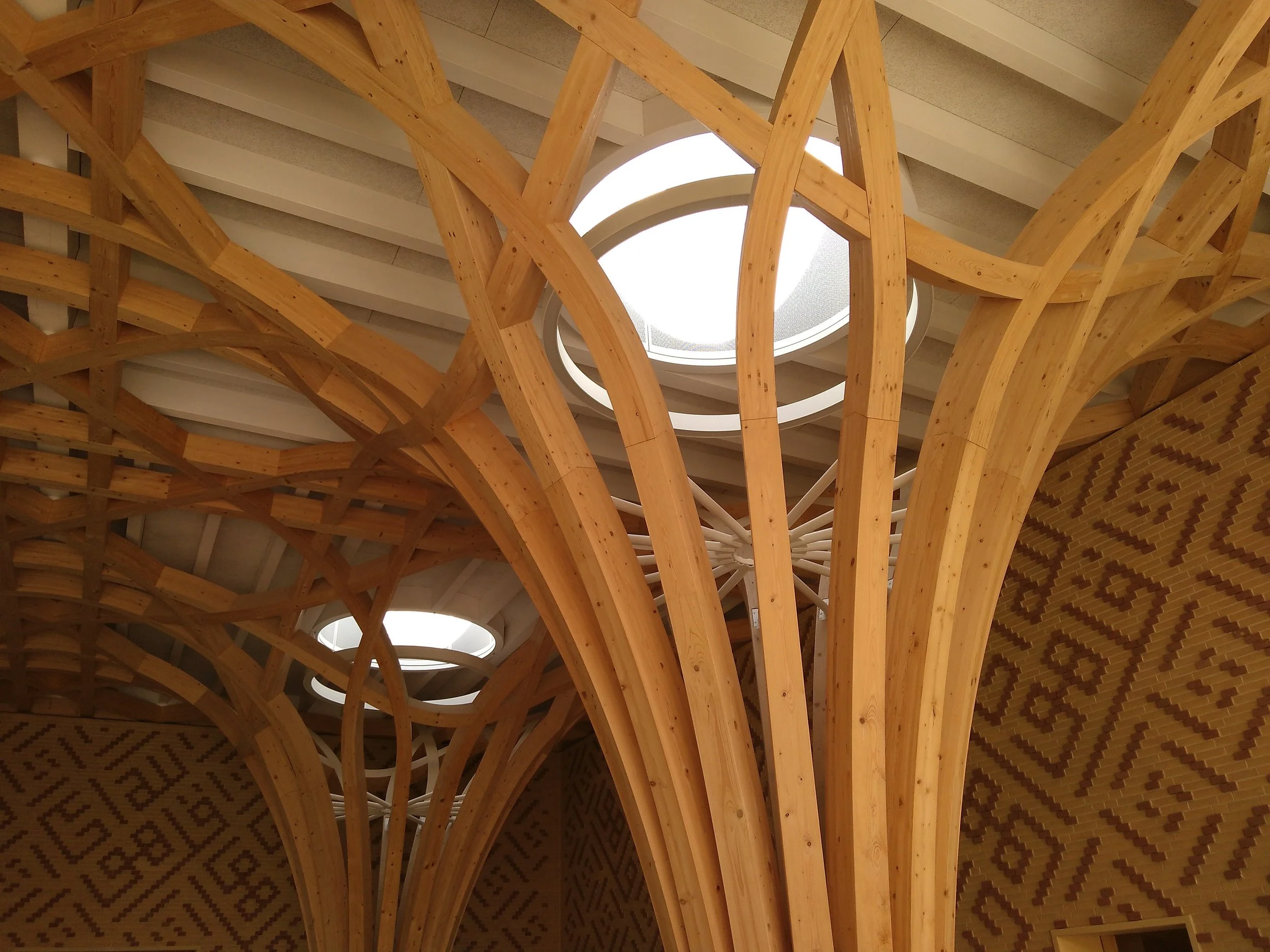
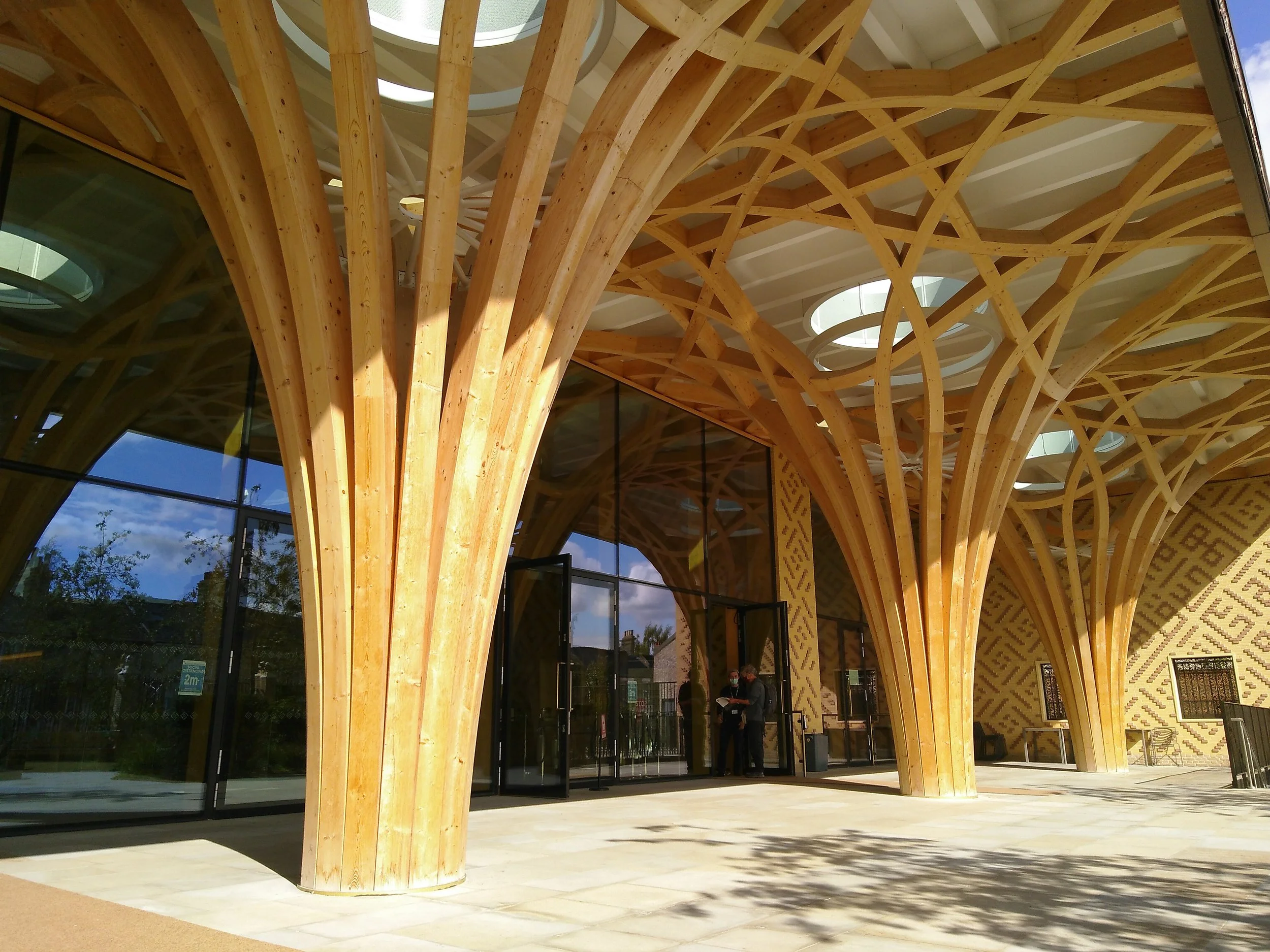
The building's most immediate identity comes from its structural columns. Fabricated from sustainably sourced spruce that is curved and laminated into glulam (glued laminated timber), the columns branch upward and outward to support the roof in a pattern described by the architects as tree-like. Each column was assembled from 145 individual components manufactured by Swiss specialist Blumer Lehmann and transported by road for on-site assembly. Above each column, a glass oculus opens to the sky, flooding the prayer hall with daylight that shifts through the space as the sun moves.
The columns are not purely metaphorical. Their geometry was developed in close collaboration with Keith Critchlow, a scholar of sacred architecture and Islamic geometry, who hand-drew the underlying geometric system that governs the entire building, from structural grid to facade pattern to atrium floor. The interlaced octagonal lattice that the columns support carries specific symbolic weight in Islamic thought: the octagon references the "Breath of the Divine" (or "Breath of the Compassionate"), a pattern used throughout Islamic art to suggest the rhythm of existence.
The same octagonal geometry deliberately recalls English Gothic fan vaulting, particularly the ceiling of King's College Chapel, Cambridge's most celebrated medieval building. This dual reference, Islamic sacred geometry and English Gothic structure, was a conscious design decision. The architects were drawing two traditions into conversation rather than choosing between them.
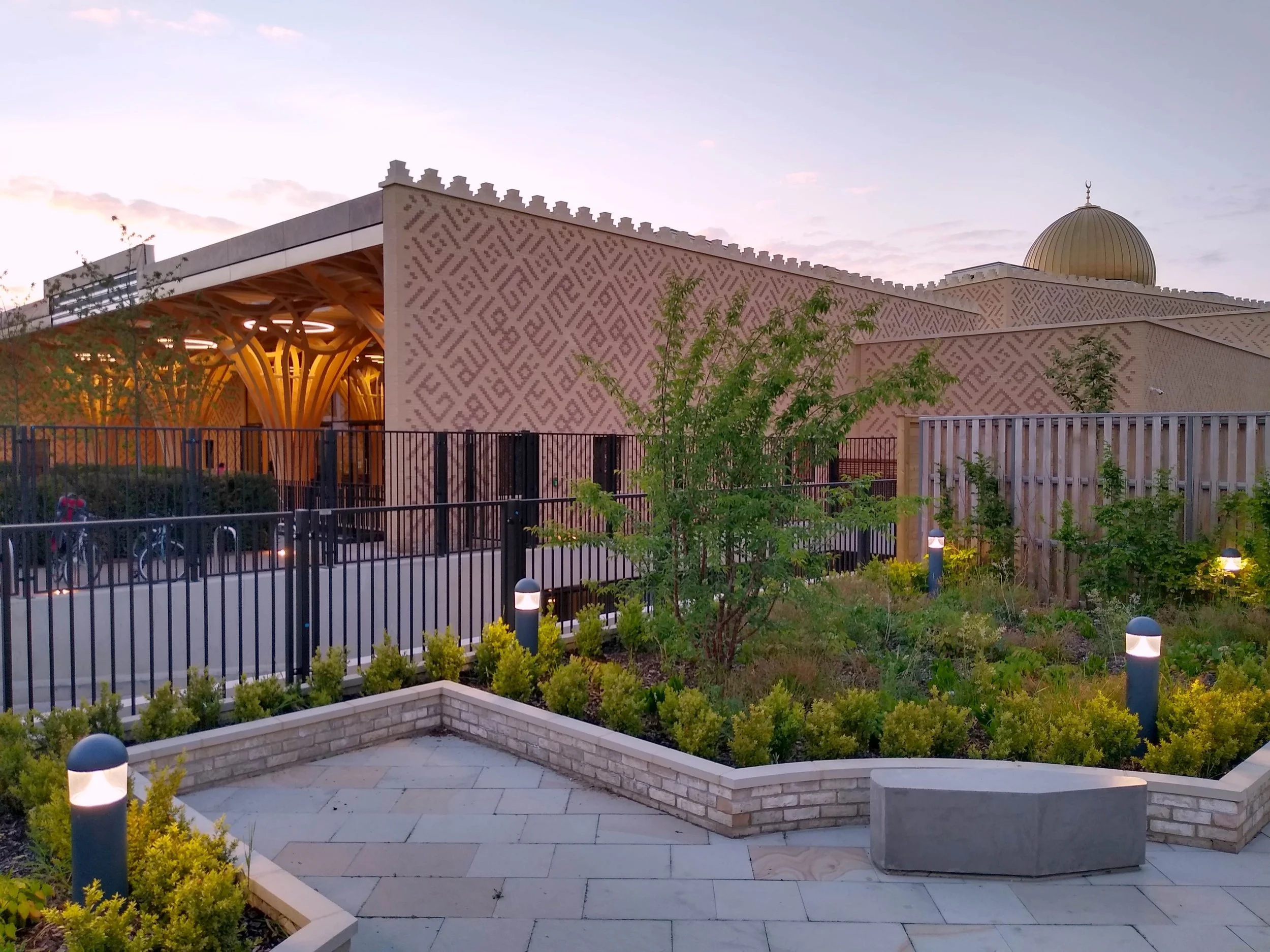
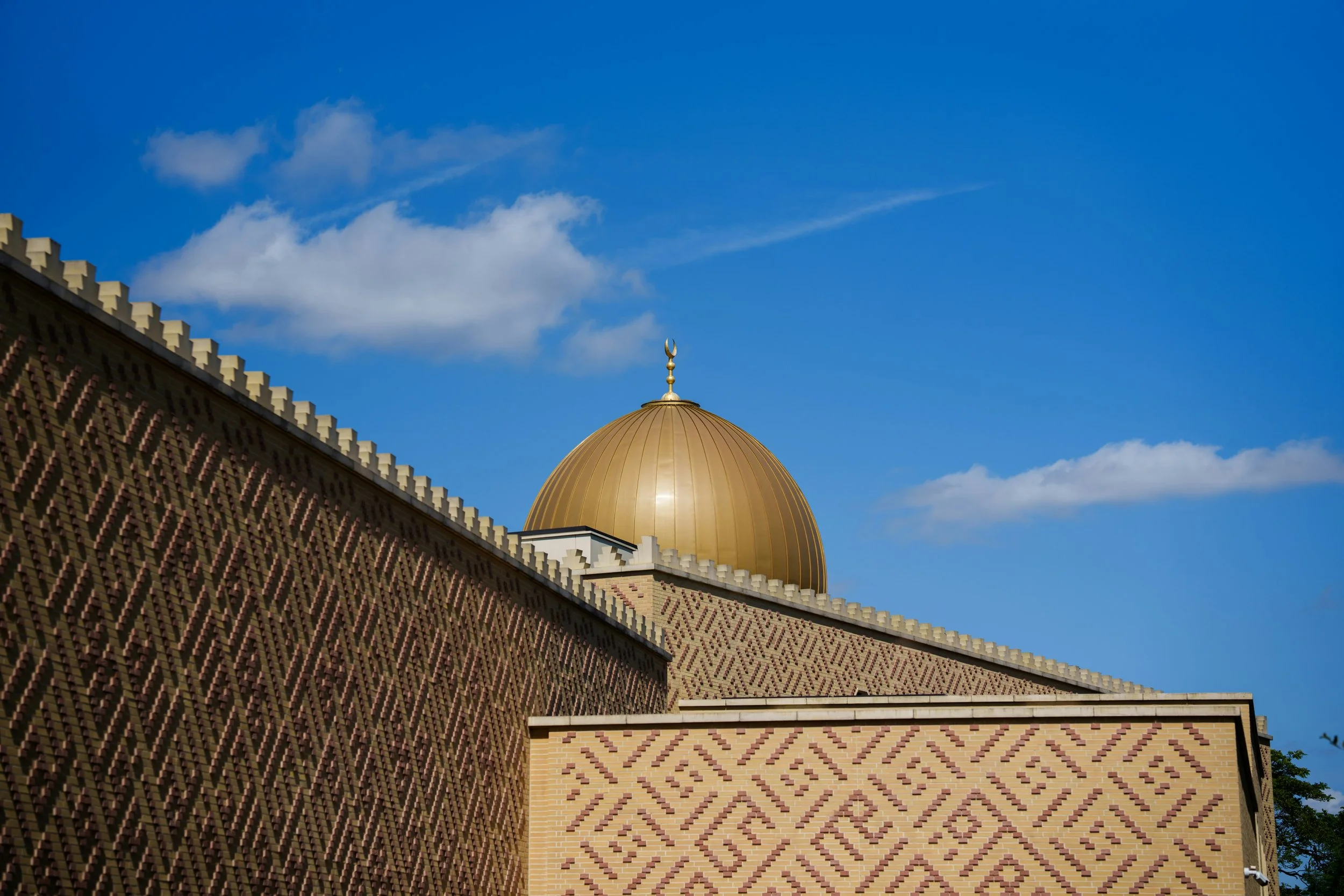
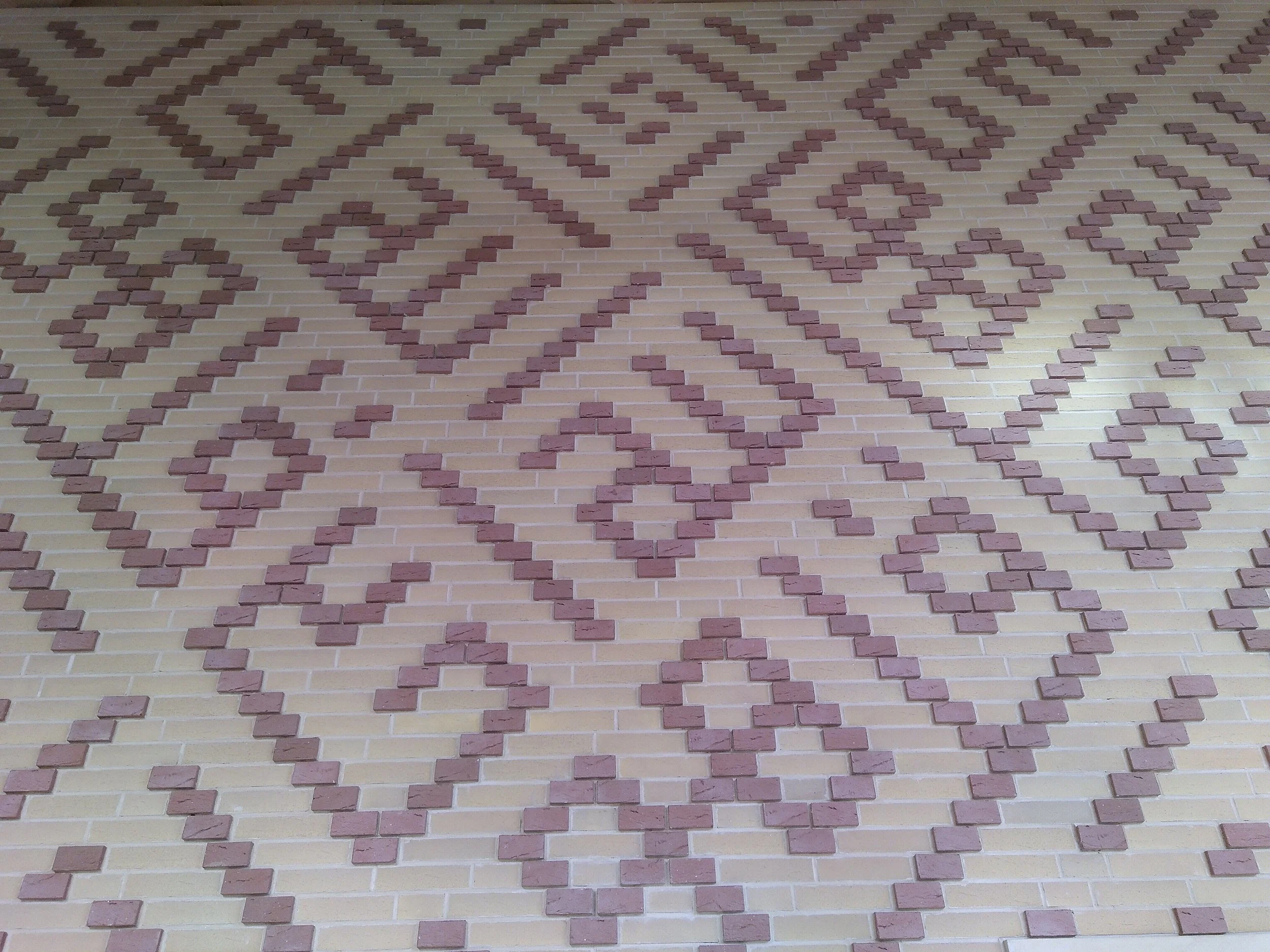
The exterior presents a three-story facade clad in Cambridgeshire gault brick tiles, the buff-yellow tone characteristic of the city's 19th-century terraced streets. The cladding is not structural; it wraps a cross-laminated timber (CLT) core. Within the brick pattern, red tile headers protrude to spell out Kufic calligraphy reading Qul huwa Allahu ahad ("Say: He is God, the One"), the opening verse of Surah Al-Ikhlas, Quran 112. This inscription is legible at close range but integrates into the overall brick texture at street distance. The roofline features a castellated parapet, which the designers describe as symbolizing the meeting of heaven and earth.
How Does the Complex Organize Space?
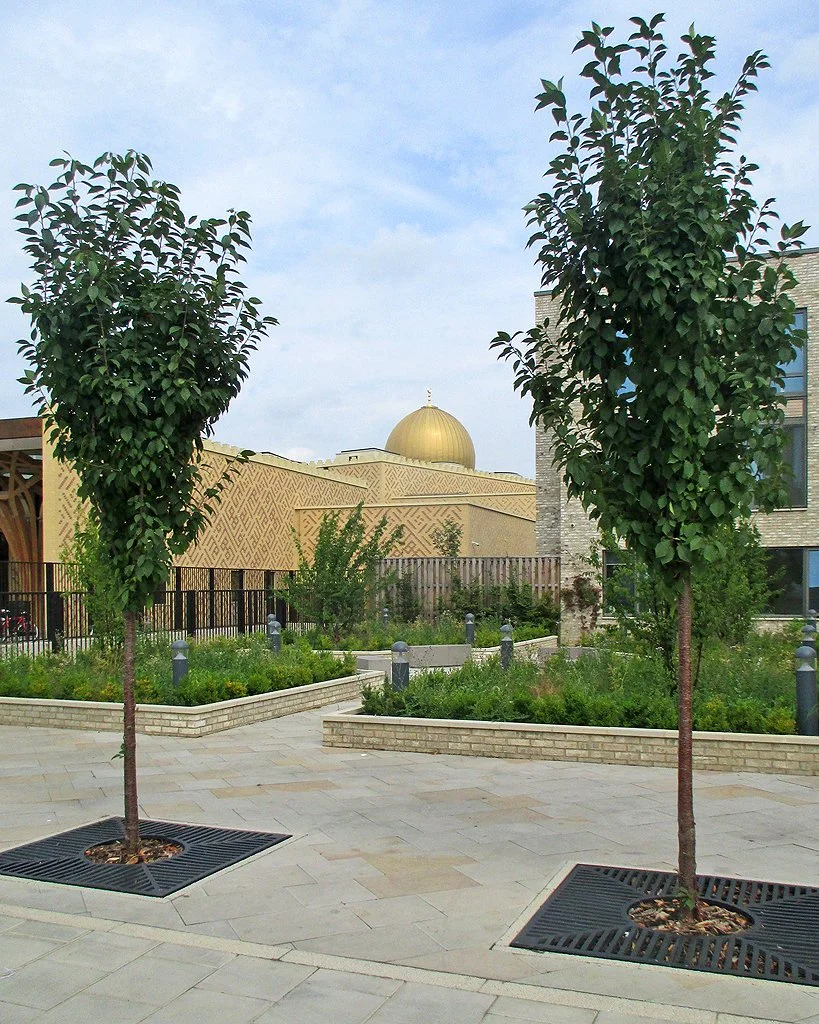
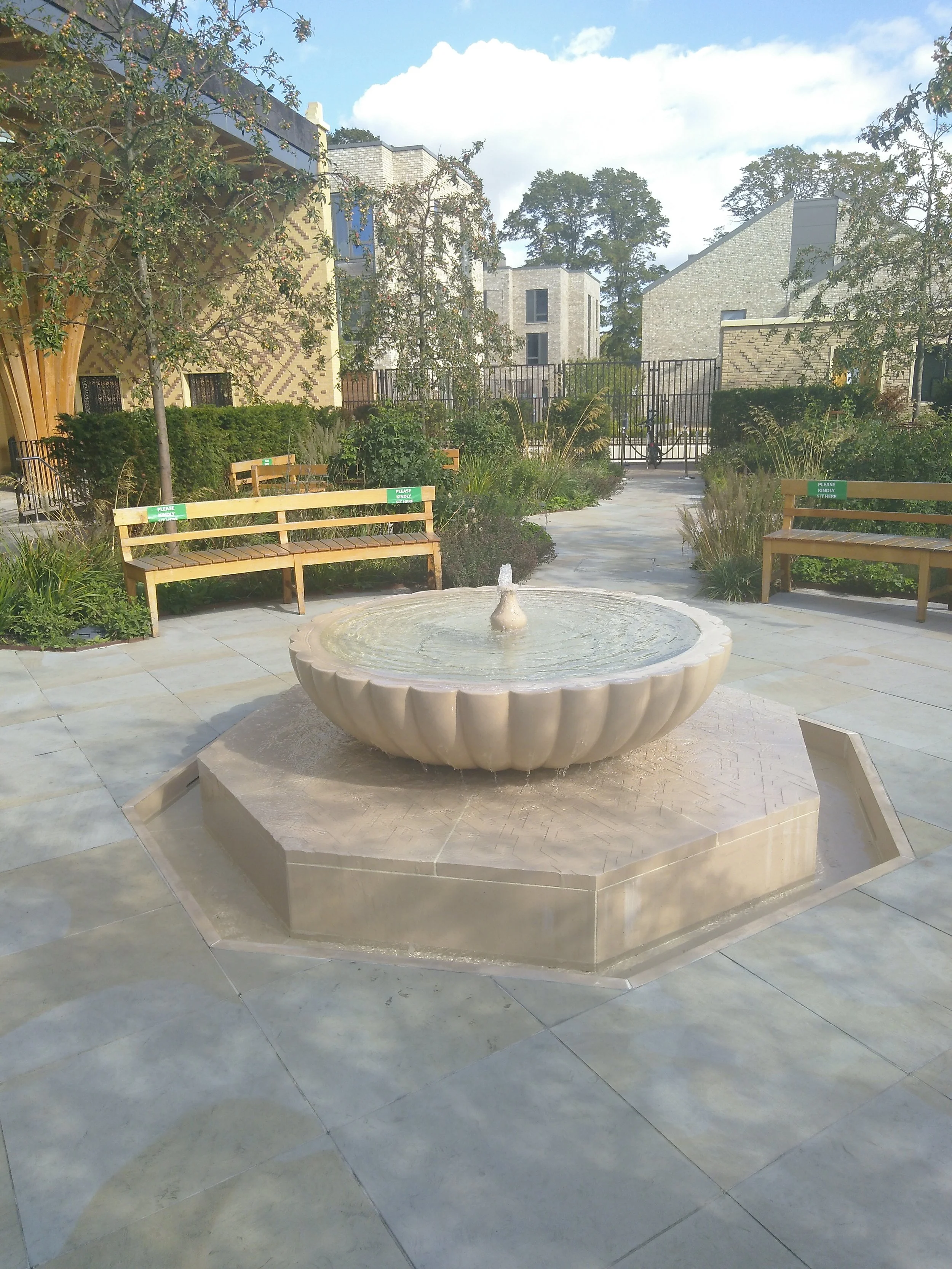
The processional sequence from street to prayer hall is the design's most deliberate spatial argument. Visitors enter from Mill Road through a formal Islamic garden, designed by Emma Clark and Urquhart & Hunt Landscape Design, which brings together traditional Islamic garden principles and a British planting palette. A central octagonal stone fountain by London-based sculptor Andrew Ewing provides the water element, flanked by oak benches, planted garden beds, and cypress trees that establish a shaded microclimate.
From the garden, the path passes under a large entrance canopy supported by four of the tree-form columns, then through an atrium where the café sits to one side and teaching facilities to the other. Ablution facilities occupy a central zone between the atrium and the prayer hall. The hall itself sits at the rear, elevated and oriented toward Mecca. The building steps upward in section as one moves inward, so the height and scale of the space increase progressively from street entry to the moment of entering the prayer hall.
The sequence replicates what Islamic architectural history has consistently used to distinguish sacred from secular space: compression and release, transition zones, and the experience of moving from the public world into a quieter and more deliberate spatial register.
The complex includes teaching rooms, a community kitchen and café, two residential units (one for the imam, one for visiting scholars), 120 bicycle parking spaces, and an underground car park for 80 vehicles. The intention was to create a genuinely functional neighborhood institution rather than a building used only for prayer times.
How Does the Prayer Hall Handle Women's Inclusion?
The mosque's approach to women's space has been a deliberate part of its public identity. The Cambridge Mosque Trust framed inclusion of women as a design priority from the competition stage, and Marks Barfield incorporated this through a flexible rather than fixed partition.
Inside the prayer hall, a mashrabiya screen (a latticed partition traditionally used in Islamic architecture for both visual separation and air circulation) separates the men's and women's sections. The screen is not fixed in place; its position can be adjusted depending on attendance, and a break at its center allows variable degrees of openness. Behind the main women's section, a glazed room offers a relatively sound-isolated but visually connected space for mothers with young children. A gallery above provides further separation for those who prefer it, accommodating different levels of practice within a single space.
All areas outside the prayer hall itself, including the garden, café, atrium, and teaching rooms, are fully shared. This organization reflects the view, held by the Trust's leadership, that mosque architecture has historically varied on gender separation and that contemporary British Muslim communities include a wide range of practice.
What Makes Cambridge Mosque Europe's First Eco-Mosque?
The sustainability brief was not a secondary concern. The design team treated near-zero carbon operation as a foundational requirement alongside spatial quality and cultural resonance. The resulting building achieves zero on-site carbon emissions through a combination of passive and active strategies.
Passive measures include the glass oculi above each column, which eliminate the need for artificial lighting during daylight hours throughout the year. The building's mass and insulation specification are designed for minimal heat loss, and natural ventilation is built into the section so air moves through the space without mechanical assistance under most weather conditions. The timber structure itself represents a low-embodied-carbon structural choice compared to steel or concrete alternatives.
Active systems include rooftop photovoltaic panels that generate renewable electricity and heat water, air source heat pumps for heating and cooling, and rainwater harvesting that supplies toilet flushing and garden irrigation through a Sustainable Urban Drainage System (SUDS). The timber, sourced from sustainably managed spruce forests, further reduces the building's embodied carbon footprint.
Abdal Hakim Murad connected this approach directly to Islamic principles about environmental stewardship, stating that Islamic civilization has long understood waste as a failure of gratitude for divine provision, and that the mosque's eco-design expresses that principle in contemporary architectural terms.
How Does Cambridge Mosque Reflect Contemporary British Islamic Architecture?
Cambridge Central Mosque participates in a wider set of debates in contemporary mosque design, most of which circle around the same underlying question: after centuries in which Islamic architecture adapted organically to new geographies, what should a mosque built in a secular Western country in the 21st century look like?
The competition brief explicitly rejected both options that have dominated British mosque building: importing South Asian or Middle Eastern forms wholesale, or occupying converted premises with minimal architectural intervention. Proposals in the 2009 competition ranged, in Murad's description, from "brutalist concrete to Star Trek futurism, replicas of medieval Syrian buildings, and revivals of Victorian architecture." Marks Barfield's winning entry took a different position: it sought a design language that was neither pastiche of historical Islamic forms nor indifferent to them, drawing instead on structural and geometric principles shared between Islamic and English sacred architecture.
The result sits alongside a small international group of contemporary mosques, including Marina Tabassum's Bait Ur Rouf Mosque in Dhaka (2012) and Glenn Murcutt's Australian Islamic Centre in Melbourne (2019), that are exploring what it means to build mosques that are genuinely of their place rather than architectural citations of somewhere else. What distinguishes Cambridge is the explicit synthesis of two local traditions, Islamic geometry and English Gothic structure, rather than adaptation to a single regional vernacular.
What Is Cambridge Central Mosque's Legacy?
The building has received significant recognition. It won the Architects' Journal Community and Faith Project of the Year in 2019, the Civic Trust Award and Special Award for Sustainability in 2020, and RIBA East Building of the Year in 2021. It was shortlisted for the RIBA Stirling Prize in 2021, the UK's highest architecture award.
Beyond awards, the mosque has contributed to a growing body of evidence that sustainable construction and sacred architecture are not in tension. The building demonstrates that near-zero carbon operation is achievable at the scale of a neighborhood religious and community center, using materials (timber, brick) with longstanding associations in both British building tradition and Islamic architecture.
For Muslim communities in Britain and elsewhere navigating questions of identity, belonging, and cultural expression, Cambridge Central Mosque offers one worked example of what integration without assimilation can look like in built form. It does not pretend that Islam arrived in Cambridge last week, nor does it pretend that Cambridge is Medina. It builds from both places at once.
Glossary:
Glulam (glued laminated timber): Structural timber engineered by bonding multiple layers of dimensional lumber together with durable adhesives, allowing curved and complex forms.
CLT (cross-laminated timber): Panels made by layering timber in alternating perpendicular directions, used here for structural walls.
Mashrabiya: Latticed screen in Islamic architecture, traditionally used for visual separation, privacy, and air circulation.
Mihrab: The prayer niche in the qibla wall, indicating the direction of Mecca.
Minbar: The elevated pulpit from which the imam delivers the Friday sermon.
Qibla: The direction Muslims face during prayer, toward the Kaaba in Mecca.
Kufic: An angular calligraphic style associated with early Arabic inscriptions and frequently used in Islamic architecture for inscriptions.
Oculus: A circular opening in a ceiling or dome admitting light.
