
Katara Mosque in Doha, Qatar




This post was last updated on January 19, 2026.
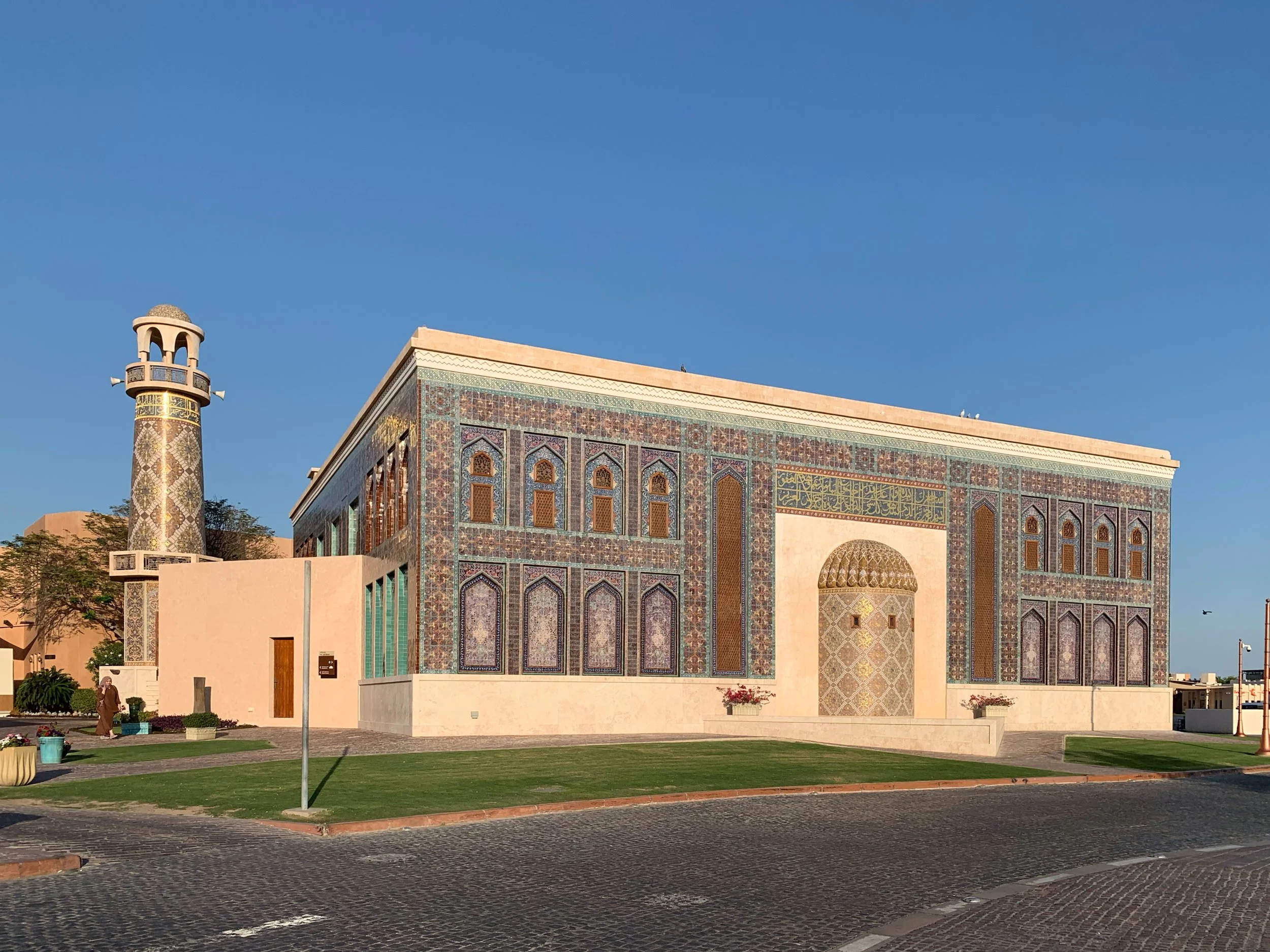
The Katara Mosque sits within the Katara Cultural Village on Doha's northern waterfront, its nine central domes and freestanding star-shaped minaret rising above a complex that opened in 2010. Commissioned as the principal mosque of a cultural district designed to position Qatar as a center for Islamic arts and heritage, the building draws from Ottoman, Persian, and Central Asian architectural traditions rather than pursuing a single regional style. Its exterior, sheathed in turquoise and purple glass mosaic tiles with 24-karat gold-leafed calligraphic panels, makes it among the most visually distinctive contemporary mosques in the Gulf. Turkish designer Zeynep Fadıllıoğlu, who became the first woman to design a mosque in modern Turkey with Istanbul's Şakirin Mosque in 2009, led the project. Decorative execution was carried out by restoration specialists drawn from Istanbul's Dolmabahçe Palace.
Who Commissioned the Katara Mosque and Why?
The Katara Cultural Village was established in 2010 under the direction of Sheikh Hamad bin Khalifa Al Thani, with the aim of creating a dedicated space for arts, culture, and heritage in Qatar. The mosque forms the religious anchor of this complex, positioned alongside an amphitheater, opera house, art galleries, and educational institutions. Its role within a deliberately designed cultural district shapes its character: it functions simultaneously as a working jami (Friday mosque) for daily congregational prayer and as an architectural statement about the place of Islamic visual traditions within a modern Gulf city.
Rather than commissioning a mosque in a single established regional style, the patronage decision to engage Fadıllıoğlu reflected a deliberate synthesis approach. Fadıllıoğlu's design philosophy, developed across projects in Istanbul, Doha, and Bahrain, draws explicitly on Ottoman heritage while adapting historical precedents for contemporary construction. Her Şakirin Mosque drew international attention for combining modern structural techniques with traditional decorative programs, and the Katara commission extended that approach to a larger, more publicly prominent scale.
The cultural village also includes a second mosque on the same grounds: the Golden Mosque (also known as the Golden Masjid), which is clad in small golden mosaic chips and represents Ottoman style. The two buildings function as a pair, offering contrasting material and formal interpretations of Islamic architecture within the same complex.
What Makes the Katara Mosque's Architecture Distinctive?
The building's exterior is its most documented feature. Hand-painted ceramic tiles and glass mosaics in turquoise, violet, and deep blue cover the facade, with coloration shifting depending on angle and light conditions. Calligraphic panels display Quranic verses using 24-karat gold-leafed glass mosaic tiles, placing the exterior inscription program in dialogue with the building's color field. Golden elements also appear on the mihrab (prayer niche), minaret, and domes, creating metallic accents against the predominantly cool-toned facade.
The nine central domes distinguish the roofscape from single-domed Ottoman mosques and from the more restrained dome configurations typical of Gulf mosques. Their grouping creates a profile that reads differently from ground level, where individual dome curves become visible above the courtyard arcade, than from a distance, where the cluster reads as a unified mass.
The freestanding minaret, designed in the form of an Islamic star in plan, stands apart from the main prayer hall rather than rising from a corner or entrance bay as in most Ottoman precedents. This separation is architecturally unusual and draws attention to the minaret as an independent formal object rather than a structural extension of the building. The minaret's surfaces continue the exterior mosaic program, with blue, white, and gold tilework particularly concentrated toward the balcony level.
How Does the Decorative Program Engage Islamic Geometric Tradition?
The decorative scheme extends from Arabic calligraphy displaying Quranic verses to traditional vegetal Islamic motifs throughout the exterior facade. Interior decoration takes a more restrained approach, with the prayer hall finished in calmer tones relative to the exterior's intensity. The decorative work was executed by restoration specialists from Dolmabahçe Palace in Istanbul, bringing Ottoman craft expertise to a Qatari context.
The mihrab receives elaborated treatment within the prayer hall, consistent with standard mosque practice where the niche indicating Mecca's direction serves as the primary focal point for decorative investment. The wooden windows throughout the building feature carved geometric patterns, extending the decorative program to joinery elements.
One specific material detail worth noting: the hand-painted ceramic tiles were custom-produced for the Katara project rather than sourced from existing tile stocks, requiring extended development of specific glaze formulations to achieve the intended color range.
What Range of Islamic Architectural Traditions Does the Mosque Draw From?
The mosque draws from architectural styles of Turkey, Syria, Turkmenistan, and northern Persia, according to multiple sources, while the decorative approach specifically references Dolmabahçe Palace's interior ornament tradition. This synthesis acknowledges that no single regional tradition could encompass the architectural diversity of the Islamic world, and positions the mosque as a deliberately pluralist statement about that heritage.
The decision has architectural consequences. Where a mosque committed to a single tradition (Mamluk, Timurid, Ottoman imperial) can achieve coherent formal logic through the internal consistency of that tradition's proportional and decorative systems, an eclectic synthesis relies more heavily on surface decoration and material quality to achieve unity. The Katara Mosque's coherence comes primarily from its sustained color and material palette rather than from structural logic.
Fadıllıoğlu has described her design philosophy as combining eastern and western aesthetics while embracing Ottoman heritage to produce work with local feel and universal appeal, a framework that shaped both the Şakirin Mosque and the Katara project. Her approach represents one response to a question contemporary Islamic architecture faces repeatedly: how to engage historical visual traditions without producing literal reproduction or losing formal integrity.
What Is the Mosque's Role in the Community and Cultural Village?
The mosque serves as Katara Cultural Village's principal prayer space, hosting daily prayers and Friday congregational worship. During Ramadan, it holds tarawih (nightly prayers), Quran recitation sessions led by invited reciters, and religious lectures by scholars from across the Arab and Islamic world. The village organization provides support facilities for worshippers observing i'tikaf (spiritual retreat) during Ramadan's final ten nights.
The mosque's position within a cultural district that explicitly welcomes non-Muslim visitors shapes its public function. Educational materials about Islam are available inside in multiple languages, and the mosque has served as a point of interfaith encounter, particularly during the 2022 FIFA World Cup when Qatar hosted large numbers of international visitors.
Glossary:
Jami: Friday mosque where congregational prayer and the weekly sermon occur
Mihrab: Prayer niche in the qibla wall indicating the direction of Mecca
Qibla: The direction Muslims face during prayer, oriented toward the Kaaba in Mecca
Tarawih: Voluntary nightly prayers performed during Ramadan
I'tikaf: Spiritual retreat practiced in a mosque, particularly during Ramadan's final ten nights

