
The Great Mosque of Djenné in Mali
.jpg)


.jpg)


This post was last updated on February 5, 2026.
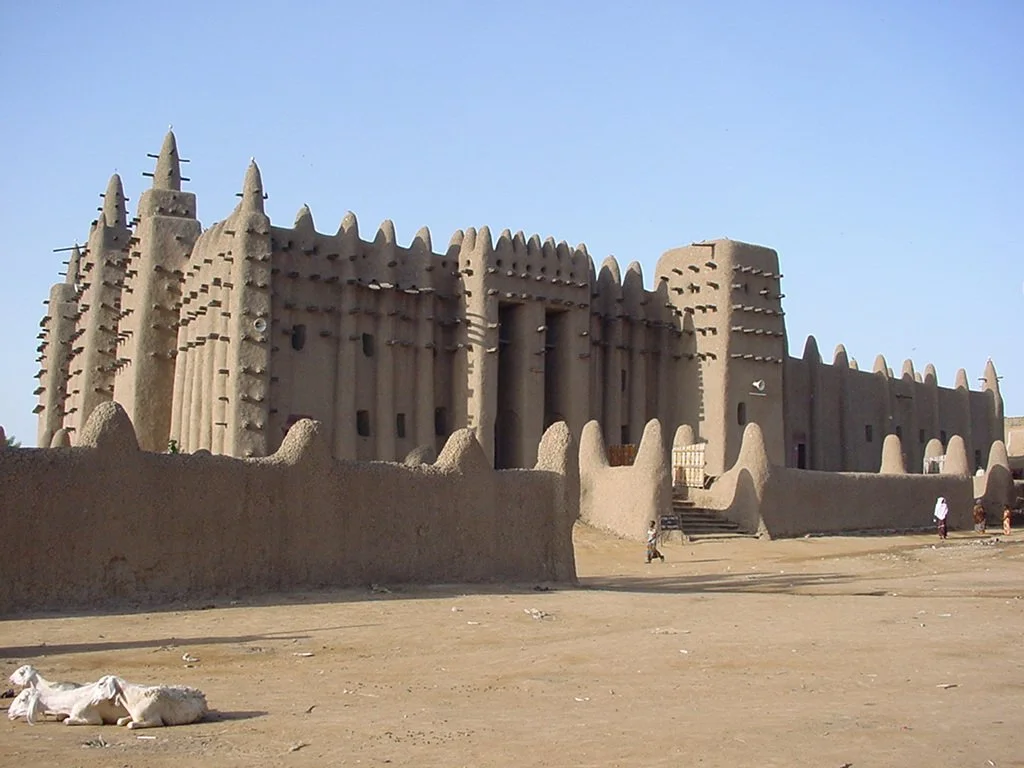
The Great Mosque of Djenné rises from the flood plain of the Bani River in central Mali as the largest adobe structure in the world. Completed in 1907 through a third reconstruction on a site with seven centuries of Muslim worship, the mosque's three minarets and projecting timber scaffolding define the visual character of an entire region's architectural tradition. Designated a UNESCO World Heritage Site in 1988 alongside the Old Towns of Djenné, the building occupies a 75-by-75-meter raised platform at the city's center, directly adjacent to the Monday market. It serves as the jami (Friday congregational mosque) for Djenné's Muslim community and as the most ambitious surviving example of Sudano-Sahelian architecture.
Who Built the Great Mosque of Djenné and Why?
The site's Islamic history extends to the 13th century. According to legend, King Koi Konboro, Djenné's 26th ruler and its first Muslim sultan, used local materials and traditional design techniques to build a place of Muslim worship. His successors added two towers and surrounded the main building with a wall. The mosque functioned alongside a dense network of Quranic schools that made Djenné a regional center of Islamic learning, closely linked to Timbuktu through the trans-Saharan gold trade.
The current structure is the third mosque on this site. The Fulani leader Seku Amadu appears to have disapproved of the existing mosque and allowed it to fall into disrepair. Between 1834 and 1836, Seku Amadu built a new mosque to the east of the existing one: a large, low building lacking any towers or ornamentation. By 1828, the French explorer René Caillié described the original as abandoned to thousands of swallows. French forces led by Louis Archinard captured Djenné in April 1893.
The present third reconstruction was completed in 1907. New scholarship supports the idea that the mason's guild of Djenné built the current mosque along with the labor of enslaved people from villages of adjacent regions, brought in by French colonial authorities. Construction was directed by Ismaila Traoré, head of Djenné's guild of masons and renowned throughout the Sahel. He was a Muslim craftsman, not a French architect, and scholarly debate over French design influence has generally concluded in favor of the guild. Jean-Louis Bourgeois recorded that the rebuilt mosque was constructed by Djenné's traditional local guild of masons using traditional techniques and with minimal French involvement. Community response was contentious from the start: local people were so unhappy with the reconstructed building that they refused to clean it, only doing so when threatened with prison.
What Makes the Great Mosque of Djenné's Architecture Distinctive?
The mosque represents Sudano-Sahelian architecture, a tradition developed across the West African Sahel that combines Islamic spatial organization with earth and timber construction systems suited to the local climate and material conditions. Unlike the masonry domes and carved stone of North African or Levantine mosque architecture, Sudano-Sahelian buildings rely on thick earthen walls, integrated timber scaffolding elements, and surfaces designed for continual renewal rather than permanent finish.
The exterior's most recognizable feature is the toron: bundles of Rodier palm (Borassus aethiopum) sticks embedded horizontally in the walls and projecting outward at regular intervals. These elements bond layers of mud plaster to the wall surface, act as integrated scaffolding for annual repairs, and create the building's distinctive spiked silhouette. It is evident from published photographs that two additional rows of toron were added to the corner buttresses in the early 1990s.
The three towers dominating the qibla wall each have a niche or mihrab in the prayer hall. The central tower rises approximately 16 meters in height, while the cone-shaped spires at the top of each minaret are topped with ostrich eggs. Ostrich eggs carry significance in local tradition as symbols of creation and renewal. The central minaret historically contained a relay room: a caller inside would repeat the imam's words to worshippers gathered in the marketplace below.
How Does the Structural System Address the Bani River Floodplain?
The mosque stands on a raised platform measuring 75 meters by 75 meters, raised 3 meters above the marketplace level to prevent damage from Bani River floods. It is accessed by six sets of stairs, each adorned with pinnacles. Djenné floods seasonally, becoming an island during the rains, and this platform elevation is the primary flood defense for the building.
The walls are made from sun-dried earth bricks known as ferey, held together with a mix of sand and earth mortar. A mud plaster coating, created from fine clay, rice husks, and butter, covers the walls, improving water resistance. Small vents in the roof are topped with removable inverted kiln-fired bowls, which, when removed, allow hot air to rise out of the building and ventilate the interior.
The walls are not strictly vertical, and the outer perimeter follows a trapezoidal rather than rectangular outline. This geometric irregularity results partly from the non-orthogonal outer walls and partly from the cumulative effect of annual replastering, which rounds and softens original angles over decades. What appears monumental is also continuously in process.
What Does the Interior Prayer Hall Reveal About Sudano-Sahelian Spatial Design?
The prayer hall, located in the eastern half of the mosque, measures 26 by 50 meters and is supported by nine interior walls running north-south. This design creates a forest of ninety massive rectangular pillars that span the interior and severely reduce the field of view. The small, irregularly-positioned windows on the north and south walls allow little natural light to reach the hall's interior. The floor is composed of sandy earth.
The interior courtyard to the west of the prayer hall, measuring 20 by 46 meters, is surrounded on three sides by galleries. Arched openings punctuate the walls of the galleries facing the courtyard. The western gallery is reserved for women's use. A tomb in the front courtyard contains the remains of Imam Almany Ismaïla, an important figure in 18th-century Djenné. The outer enclosure wall defines the mosque complex's boundary, separating the sacred precinct from the adjacent market.
How Does the Crépissage Festival Connect Architecture to Community Practice?
During the annual festival of the Crépissage de la Grand Mosquée, the entire city contributes to the re-plastering of the mosque's exterior by kneading into it a mud plaster made from a mixture of butter and fine clay from the alluvial soil of the nearby Niger and Bani Rivers. The men of the community usually take up the task of mixing the construction material. As in the past, musicians entertain them during their labors, while women provide water for the mixture. Elders also contribute through their presence on site, sitting on terrace walls and giving advice.
The Crépissage is not supplementary to the building's nature but constitutive of it. Without annual replastering, the exterior would erode within a few years, exposing the ferey bricks to water damage that would compromise structural integrity. The building cannot be separated from the labor sustaining it. This relationship, where communal maintenance is architecturally necessary, distinguishes earth construction from stone or fired brick and gives the mosque its particular character as a living rather than fixed structure. Over the years, Djenné's inhabitants have withstood repeated attempts to change the character of the exceptional mosque and the nature of the annual festival.
How Does the Great Mosque Reflect West African Islamic Architecture?
The mosque sits within a broader tradition of Sudano-Sahelian building that includes the Djingareyber Mosque in Timbuktu (begun 1327) and the Sankore Mosque, also in Timbuktu. These structures share earth construction, timber scaffolding integrated into the wall surface, and vertically emphasized facades with buttresses. Djenné's mosque distinguishes itself through its scale and the elaboration of its qibla facade with three full minarets rather than one.
This tradition is a corrective to the assumption that "Islamic architecture" refers primarily to tile-covered domes, marble columns, and carved stone. West African Muslim communities developed building systems suited to their climate, available materials, and labor organization. The Sudano-Sahelian mosque type demonstrates that the functional requirements of Islamic worship (orientation toward Mecca, space for congregational prayer, a call to prayer visible across the city) can be resolved through entirely different material vocabularies.
Since the civil war in Northern Mali in 2012, the government has had limited bandwidth to deal with all of the various measures necessary to successfully protect, maintain, and monitor these sites. In 2016, torrential rains led to massive floods that left the Great Mosque with significant cracks in its pillars. Conservation work continues through UNESCO partnerships, though the preservation situation remains precarious.
Glossary:
Ferey: Sun-dried mud bricks made from local clay mixed with rice husks, the primary structural material of Djenné's architecture
Toron: Bundles of Rodier palm sticks embedded in and projecting from exterior walls, serving simultaneously as built-in scaffolding and defining surface ornament
Qibla: The direction of prayer toward the Kaaba in Mecca; in this mosque, marked by the east wall and its three minarets
Mihrab: Prayer niche in the qibla wall indicating the direction of Mecca
Jami: A Friday congregational mosque where communal prayers and sermons take place
Sudano-Sahelian: An architectural style developed across the West African Sahel, characterized by earth construction, projecting timber elements, and vertically buttressed facades
Crépissage: The annual community replastering festival particular to the Great Mosque of Djenné

.jpg)


.jpg)
