
Islamic Cultural Center of New York in New York City, United States

.JPG)

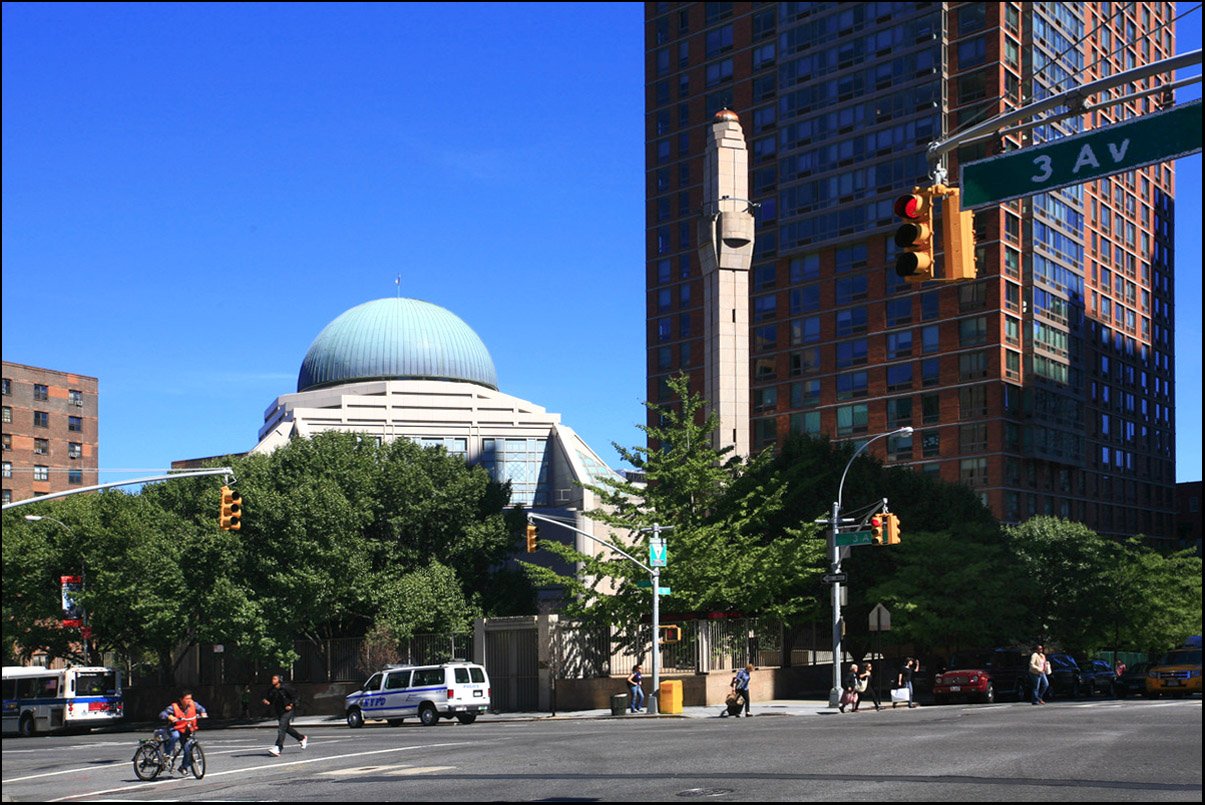
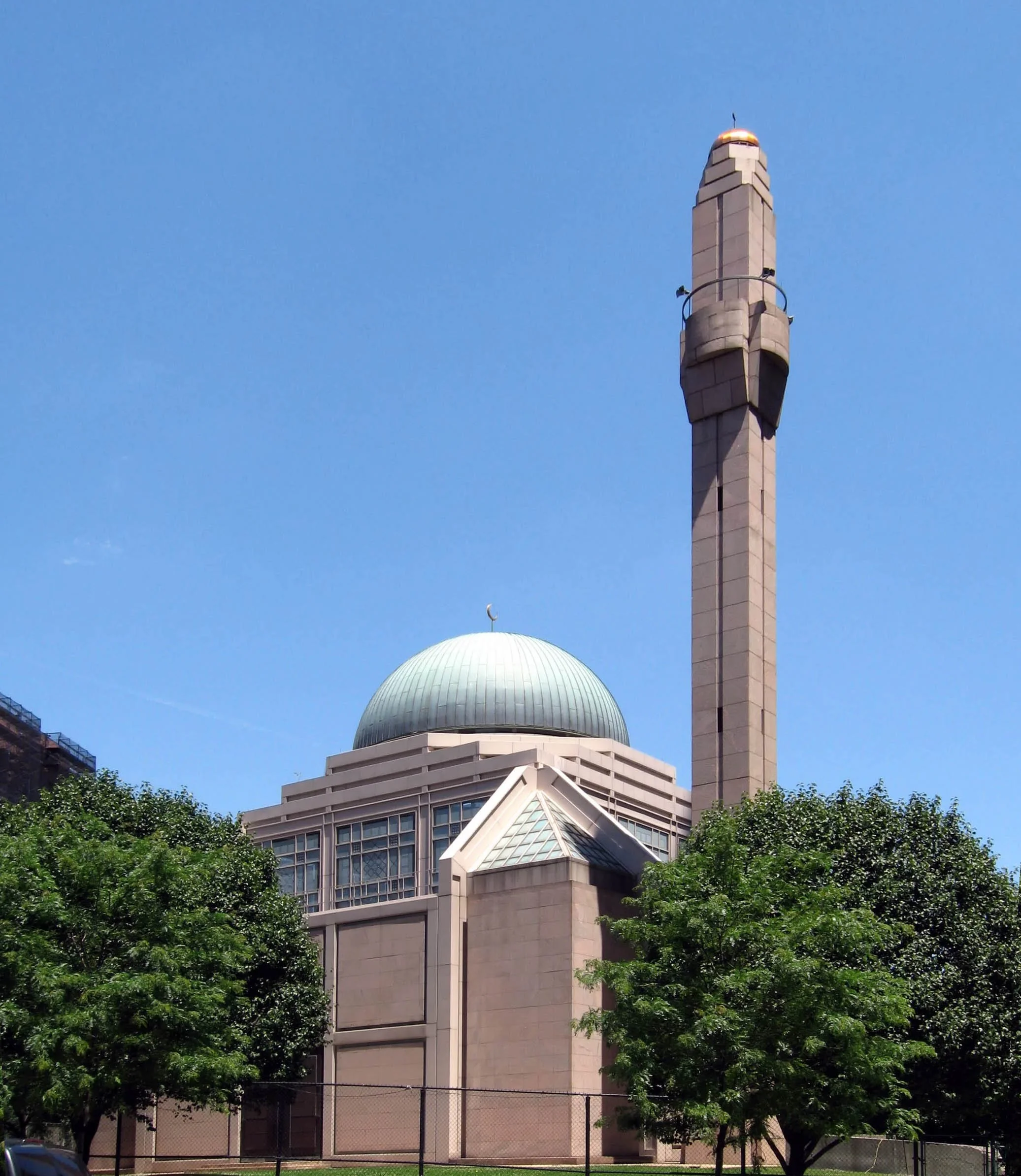
The Islamic Cultural Center of New York, completed in 1991 in East Harlem, Manhattan, was the first mosque built from the ground up anywhere in New York City. Designed by the architecture firm Skidmore, Owings & Merrill (SOM), the building occupies a full city block at the corner of Third Avenue and East 96th Street. Its most distinctive feature is invisible from a distance but obvious once pointed out: the entire structure sits rotated 29 degrees off Manhattan's street grid, a deliberate geometric shift that allows the prayer hall to face Mecca. Funded by Kuwait and dozens of countries through their United Nations delegations, the center followed a state-patronage model atypical in the American mosque landscape, where congregational fundraising is the norm. Its cubic form, copper dome, and granite cladding translate centuries-old Islamic geometric principles into a building that is unmistakably a product of late twentieth-century American construction.
Who Built the Islamic Cultural Center of New York and Why?
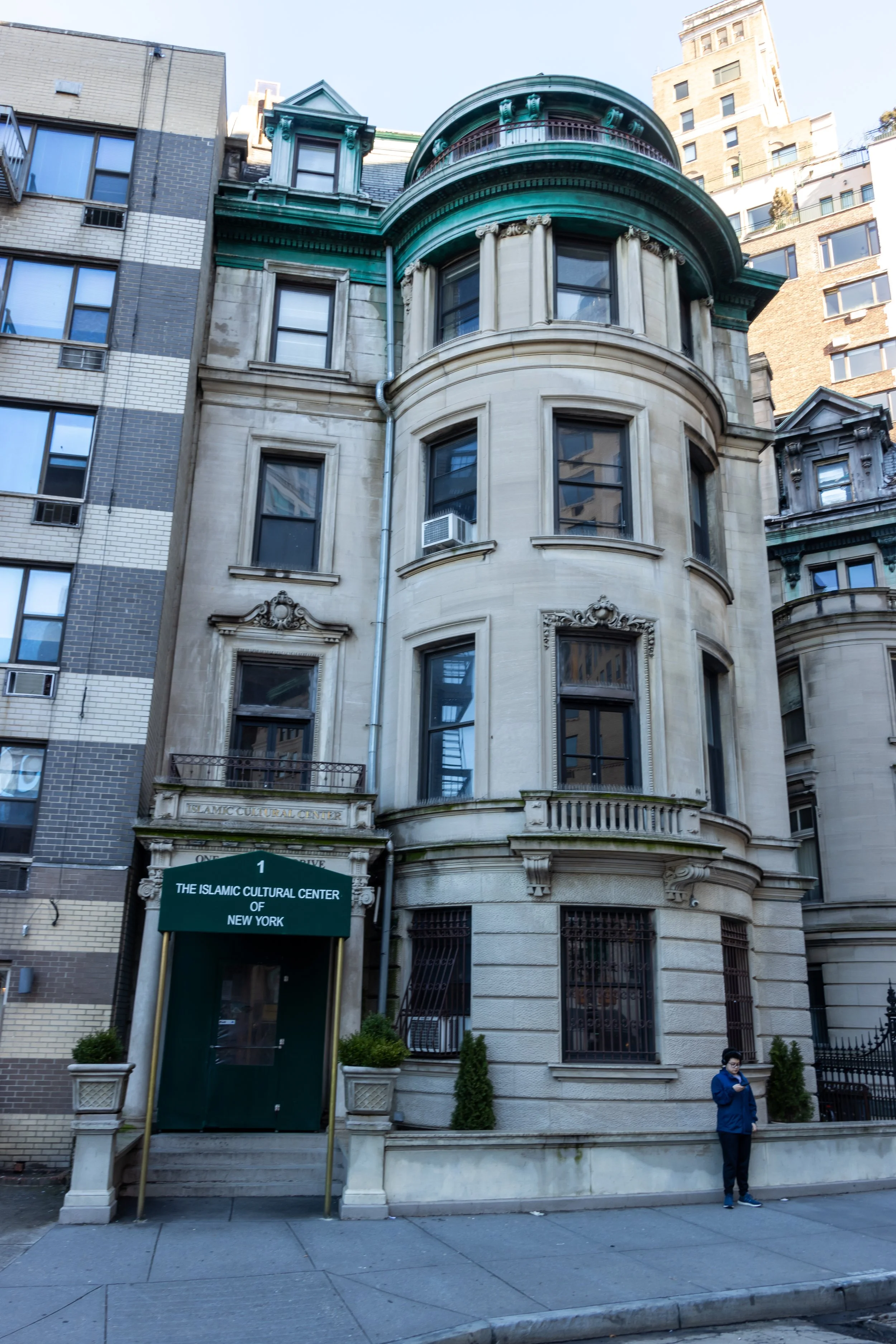
The project's roots reach back to the early 1960s, when New York's growing Muslim population, including many United Nations diplomats from Muslim-majority countries, organized a religious and cultural institution to serve the city. Their first home was a modest townhouse at 1 Riverside Drive, which still functions today as a satellite prayer location. The center's board of trustees, composed largely of UN ambassadors, wanted something more permanent and more visible: a purpose-built mosque, school, library, and lecture hall that could stand among New York's other major religious landmarks.
Fundraising and planning stretched from 1966 through the mid-1980s, complicated by the need to relocate tenants and demolish existing buildings on the chosen site. In 1987, the trustees reached an agreement with SOM, and groundbreaking followed that May, timed to coincide with the end of Ramadan. Kuwait led the funding effort, joined eventually by 46 Muslim-majority countries whose combined contributions covered roughly $17 million in construction costs. Work slowed again in 1990 when the Iraqi invasion of Kuwait disrupted both funding and morale, but the mosque opened its doors on April 15, 1991, for Eid al-Fitr, with a formal dedication ceremony that September.
What Makes the Islamic Cultural Center's Architecture Distinctive?
SOM's central design move was geometric rather than decorative. A single organizing principle, the square, governs the building from its footprint to its surface ornament. The mosque fits within a cube roughly 27 meters (90 feet) across, and overhead, four steel trusses cross at measured intervals to form a grid of nine bays that carries the copper dome. No columns interrupt the floor below. This is the same engineering logic that has allowed domed mosques for centuries to open up large congregational spaces, here translated into a modern steel frame rather than masonry vaulting.
The exterior reflects that internal logic in three visible tiers: a base of pink granite quarried in Stony Creek, Connecticut, a middle zone of glass and granite set back from the tier below, and the dome rising above. A freestanding minaret, reported at roughly 40 meters (130 feet), stands apart from the main volume. What makes the building work as a piece of urban design, not just religious architecture, is the 29-degree rotation already mentioned in the introduction. Pulling the mosque's geometry away from Manhattan's grid does more than satisfy the requirement to face Mecca. It distinguishes the building from its rectilinear neighbors, opens additional surfaces to natural light, and creates an outdoor forecourt where worshippers can gather before prayer, a function that a traditional open courtyard, or sahn, would have served in earlier Islamic architecture had the dense urban site allowed for one.
The Mosque Complex: Spatial Organization and Structures
The full site spans roughly 48,200 square feet (4,478 square meters), with the building itself occupying about 21,176 square feet (1,967 square meters) of that footprint, dimensions consistent with the block-long plot reported in architectural literature on the project. The complex comprises three principal elements: the domed mosque, an assembly and administrative wing, and the freestanding minaret. Inside, two floors separate men's and women's facilities, each with its own washrooms and meeting space, while the main congregational hall occupies the space beneath the dome, with a suspended women's gallery functioning as a balcony level within that same volume.
The entrance is marked by 15-foot bronze doors, above which a geometric arch of cut glass and a band of contemporary Kufic calligraphy, an angular early form of Arabic script, frame the portal. Moving inward, the space opens toward the qibla wall, where a glass-paneled mihrab marks the direction of Mecca. The forecourt created by the building's rotation gives the complex a transitional outdoor space that doubles as a practical solution to a constrained urban lot.
How Does the Mosque's Geometry Solve an Urban Problem?
Every mosque must orient its prayer hall toward Mecca, but few buildings make that requirement so structurally visible as this one. The mosque faces a compass heading of roughly 58 degrees, calculated using the great circle, the shortest path between two points along the curved surface of the Earth, rather than a straight line drawn on a flat map. Because Manhattan's own street grid is already angled 29 degrees from true north-south, the result is a mosque rotated a further 29 degrees from the surrounding blocks. Notice that this single calculation drives nearly every major design decision in the building: the angle of the forecourt, the orientation of the dome's structural grid, and the position of the mihrab relative to the entrance.
The calculation has become something of a local legend. Neil deGrasse Tyson, writing for the American Museum of Natural History's Natural History magazine, used the mosque's orientation as a teaching example of great-circle geometry, the same principle that determines transoceanic flight paths. For a building serving a UN-affiliated, internationally funded congregation, the choice to ground its design in precise astronomical and geodesic calculation, rather than approximate compass orientation, fits a community whose members understood Mecca's direction in genuinely global terms.
How Does Light Define the Prayer Hall?
SOM treated daylight as a primary design material, not an afterthought. Vertical glass strips interrupt the granite exterior at intervals; a horizontal reveal sits between the dome's base and the wall below it; and a ring of clerestory windows near the top of the prayer hall carry fritted ceramic patterns that break direct sunlight before it reaches the interior. Each aperture sits at a different height and angle, so the quality of light shifts as a visitor moves through the building. The effect is a graduated brightening rather than a single source of illumination flooding the space uniformly.
Artificial lighting works in the same register. Steel wires suspend a circular ring of lamps from the dome above the congregation, an arrangement that echoes a practice stretching back more than a millennium: in mosques like Ibn Tulun in Cairo, rings of oil lamps hung above worshippers in much the same configuration, long before electricity made the form a deliberate design reference rather than a practical necessity. The lighting design received a 1993 Award of Excellence from the International Association of Lighting Designers, along with a 1993 IESNY Lumen Citation.
How Does the Islamic Cultural Center Reflect Late Twentieth-Century Mosque Architecture?
The building belongs to a generation of mosques built for Muslim diaspora communities in Western cities during the late twentieth century, projects that had to reconcile Islamic spatial and decorative traditions with the structural systems, zoning constraints, and architectural vocabularies of their host cities. Where a mosque like Cambridge Central Mosque, built nearly three decades later, would resolve that tension by fusing Islamic geometry with English Gothic timber construction, SOM in 1991 reached for a different synthesis: cubic massing and a steel-truss dome borrowed from American commercial construction, paired with granite cladding, copper, and a calligraphic entry ornament rooted firmly in Islamic visual tradition.
The result is frequently described as postmodern in its handling of historical reference, a building that quotes Islamic architectural forms abstractly rather than reproducing them literally. It also reflects an unusual funding and governance model. Rather than emerging from a single local congregation's fundraising, as most American mosques have, the center was conceived and financed by a coalition of UN diplomatic missions led by Kuwait, giving the building something closer to the patronage structure of historical royal or state-sponsored mosques than to the grassroots model typical of immigrant Muslim communities in the United States.
What Is the Islamic Cultural Center of New York's Legacy?
More than three decades after its opening, the center remains one of New York City's largest mosques. Its main prayer hall holds roughly 1,000 worshippers, though Friday congregational prayers regularly draw crowds reported at close to 4,000, filling the forecourt and surrounding sidewalks. The building has aged into its setting rather than away from it: the copper dome has fully oxidized and the trees on the site have grown to create a shaded green space outside, outcomes the architects anticipated when they described the building as designed to age gracefully over time.
The center continues to operate a school and daily prayers. Its 1 Riverside Drive predecessor remains active as a satellite location, preserving a direct link to the institution's origins decades before the 96th Street building existed. As later, more contested proposals for Islamic cultural centers in Manhattan, most notably the Park51 controversy of 2010, would demonstrate how fraught mosque construction in the city could become, the Islamic Cultural Center of New York stands as an earlier, largely uncontroversial precedent: proof that a purpose-built mosque could become an accepted civic landmark rather than a flashpoint.
Glossary:
Mihrab: A niche set into the qibla wall of a mosque, marking the direction of prayer toward Mecca.
Qibla: The direction of prayer toward the Kaaba in Mecca.
Sahn: An open courtyard within a mosque complex, traditionally used for overflow prayer and community gathering.
Kufic: An early, angular form of Arabic calligraphy, frequently used in architectural ornament.
Great circle (geodesic): The shortest path between two points along the curved surface of a sphere, used to calculate accurate qibla directions from distant cities.
