Auburn Gallipoli Mosque in Auburn, Sydney, New South Wales, Australia
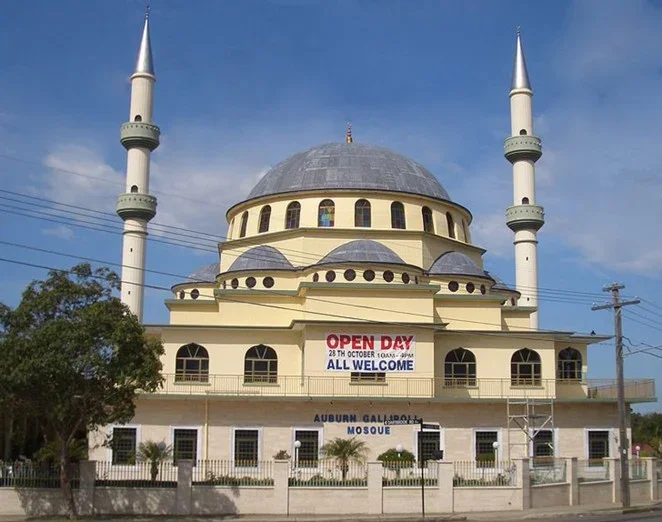
Sydney's Auburn Gallipoli Mosque holds a singular position in Australian Islamic architecture: it is the only Ottoman-style mosque in the country's largest city, built by a migrant community using a design drawn directly from Turkey's religious affairs authority. Completed in 1999 after thirteen years of construction funded almost entirely by the Australian Turkish Muslim community, the mosque stands at 15-19 Gelibolu Parade in Auburn, a suburb in western Sydney. Its central dome rises 22.6 meters above the prayer floor, flanked by two minarets standing 34 meters each. More than 500 worshippers attend daily, with Friday prayers drawing crowds of around 2,000. What makes this building worth studying isn't only its scale. It's the story of how it got built, and what the community refused to compromise on along the way.
Who Built the Auburn Gallipoli Mosque and Why?
The mosque's origins lie in a 1968 bilateral agreement between the Australian and Turkish governments establishing an assisted migration program. Turkish families arrived steadily through the early 1970s, settling predominantly in Auburn and surrounding suburbs after initial processing at the Villawood Migration Centre. By 1979, the community had turned a house at the corner of what is now Gelibolu Parade into a prayer space by removing internal walls. This makeshift arrangement served the community while they organized toward something more permanent.
By 1980, with two neighboring properties acquired, the committee resolved to build a purpose-built mosque. They faced two problems at once: no reserve of funds large enough for a significant building project, and no local expertise in Ottoman mosque design. For the design problem, they went straight to the source. The community approached Diyanet, Turkey's Presidency of Religious Affairs (the government body that administers mosques and imams across Turkey), and requested a mosque plan from their archives. Diyanet provided a plan based on the Marmara University Faculty of Theology Mosque in Istanbul, a building that exemplified classical Ottoman conventions. That original mosque was later demolished in 2012 due to earthquake risk and replaced by a contemporary structure; a separate replica of the original also exists in Eskisehir. Auburn's mosque was drawn from the same source design as that Eskisehir replica, making both buildings sibling interpretations of an original that no longer stands.
Australian architect David G. Evans was brought in to adapt the plan to local building codes. In 1985, he traveled to Turkey with a mosque committee member to properly understand what he was working with, visiting mosques and meeting architectural firms that specialized in Ottoman design. That trip led him to Turkish architect Leyla Baydar Guven. She arrived in Sydney in September 1986 and immediately identified structural features that had been cut from the design for budget reasons. She brought them back. Her intervention changed the building's spatial character in ways that go far beyond aesthetics (more on that below).
Construction ran from 1986 to 1999. The community contributed approximately six million Australian dollars over those thirteen years, with builder Ahmet Asim donating much of his own time to the project. The mosque opened officially in November 1999.
The name was chosen to acknowledge the bond formed between Turkish and Australian soldiers during the 1915 Gallipoli Campaign. A plaque on the wall captures the intention clearly: the mosque "reflects the shared legacy of Australian society and the main community behind the construction of the mosque, the Australian Turkish Muslim Community."
What Makes the Auburn Gallipoli Mosque's Architecture Distinctive?
The building covers 4,000 square meters and uses a concrete frame with masonry walls lined in travertine stone and marble imported from Turkey. That material choice was intentional. The committee wanted the mosque to feel authentically Ottoman, and travertine, with its warm pale tones, connects the building visually to the stone mosques of Istanbul and Bursa.
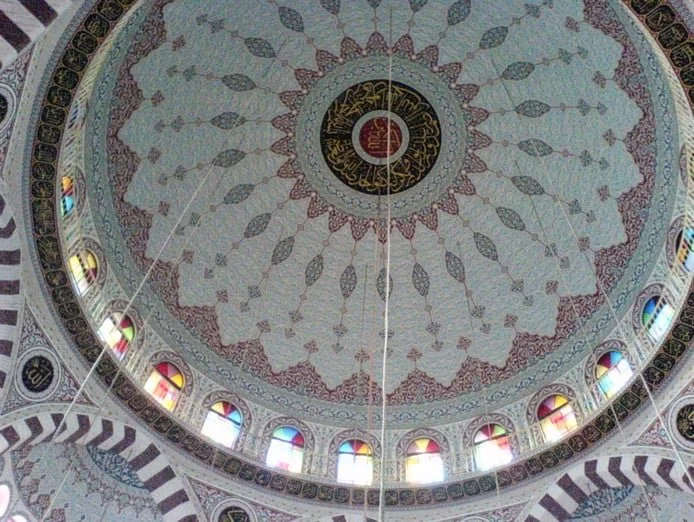
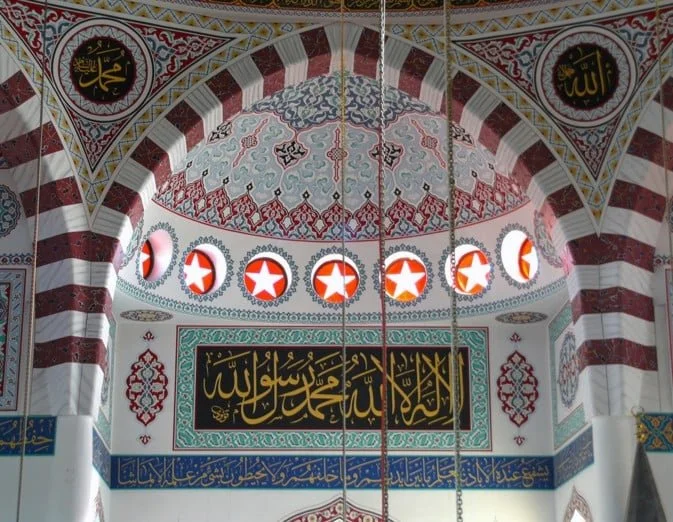
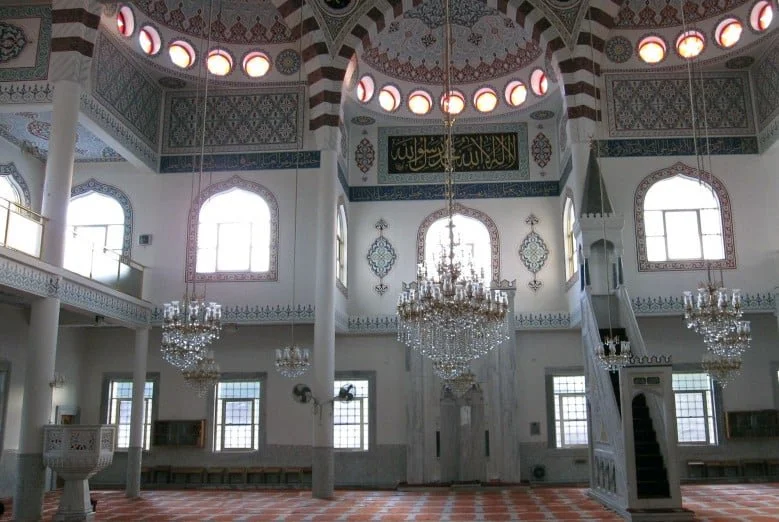
The floor plan is square, topped with a dome system that follows classical Ottoman logic: one large central dome with an internal circumference of 16.6 meters, surrounded by eight smaller semi-domes. Below each dome runs a band of evenly spaced windows filled with colored glass. These windows were originally cut from the design to reduce costs. Leyla Baydar Guven reinstated them, and that decision matters enormously. In Ottoman mosques, this ring of windows at the drum makes the dome appear to float above the space rather than simply sit on it. The light shifts across the walls and mosaic floors throughout the day. Without those windows, the prayer hall would feel like a sealed vault. With them, it breathes.
The dome was originally clad in copper, which developed a dark bluish-grey patina that worked well against the pale travertine walls. In 2006, the committee brought in a team of Turkish roofing specialists to reline it with lead, the historically accurate material for Ottoman domes. The two minarets, each with two tiers of external balconies, follow the cylindrical Ottoman form and make the mosque visible from a considerable distance across the suburb.
The Mosque Complex: Beyond the Prayer Hall
The site at Gelibolu Parade holds more than the mosque building itself. There's a playground for children, a community hall used for a weekly youth group and available for hire, and a gym in a low extension to the mosque's north side. Next door stands the Gallipoli Home, a purpose-built aged care facility serving the Turkish and Muslim community of the area. Women's prayer occupies the second floor, accessible by stairs and lift; men's prayer is on the first level. Ablution facilities are maintained separately for each congregation.
The mosque's position beside the Main Western Railway Line gives it a prominent visual presence in Auburn's urban landscape. Its dome and minarets are visible from the railway corridor, functioning as a civic landmark for the suburb in the way that a church spire or municipal tower traditionally would. This visibility is not incidental: it announces the presence of a Muslim community in western Sydney with the same architectural confidence that the Ottoman mosques of Istanbul asserted Islamic civilization in their own contexts.
How Does the Dome System Work?
Classical Ottoman mosque architecture, developed most fully in the 16th-century work of Mimar Sinan (chief architect to the Ottoman sultans), solved a structural puzzle: how do you cover a large prayer hall without filling it with columns that would break up the worship space? Sinan's answer was to cascade the dome's weight outward through a sequence of smaller half-domes and down through clustered piers to the perimeter walls. The interior stays open. Worshippers have a clear view of the qibla wall (the wall facing Mecca) and the mihrab (prayer niche).
At Auburn, this same logic was adapted into a concrete frame rather than cut stone. The key is that Guven insisted the load path follow Ottoman principles rather than simply applying Ottoman ornament to an unrelated structure. The difference is more than theoretical. A prayer hall where the structural system actually works the way Ottoman architecture intended feels spatially different from one where Ottoman ornament has been applied to a generic modern building. The unobstructed space, the floating dome, the light from the drum windows: these effects require the structural decisions to be right, not just the decoration.
How Was the Interior Made?
The interior craft program at Auburn is worth looking at closely. Calligrapher Huseyin Oksuz designed the full calligraphic scheme for the dome interior and walls. Five Turkish artists then traveled to Sydney and painted the program over six months, working directly on-site. This is a traditional Ottoman working method: a master calligrapher provides the design, a skilled team executes it. The same division of labor organized the great Ottoman mosque decoration programs of the 16th and 17th centuries.
The crystal chandeliers throughout the interior were designed and manufactured in Turkey using traditional production methods. The entrance doors came from Turkish craftspeople working in Ottoman timber joinery traditions. The carpet, which marks the congregation's prayer rows, was designed in Istanbul. Almost every significant interior element was either made in Turkey or designed by Turkish artisans specifically for this building.
This matters because it distinguishes Auburn from many contemporary diaspora mosques where Ottoman or Mughal visual references are achieved through mass-produced tiles or prefabricated elements. The committee's commitment to sourcing authentic Turkish craft work extended the construction timeline significantly but produced an interior with real material weight behind its historical references.
The mihrab is detailed in carved marble. Adjacent to it stands the minbar (the raised pulpit from which the imam delivers the Friday sermon), also in carved marble. The khutbah (Friday sermon) is delivered in Turkish, reflecting the composition of the congregation.
How Does the Auburn Mosque Fit into the Bigger Picture?
The Auburn Gallipoli Mosque sits in an interesting place when you consider how Ottoman architecture has traveled across the world. Compare it to Baiturrahman Grand Mosque in Banda Aceh: there, Dutch colonial architects imposed Mughal Revival forms on an Acehnese community that had its own pre-colonial mosque tradition. The Ottoman dome-and-minaret aesthetic arrived as a colonial imposition, not a community choice.
Auburn reverses that dynamic entirely. A migrant community sought out Ottoman architecture for themselves, raised their own funds, engaged a Turkish architect to protect the tradition's integrity, and built something that reflects their own cultural heritage rather than an outside preference. The constraints were real (budget cuts, local building codes, an unfamiliar climate) but the decisions about what to preserve were made by the community, not for them.
At the same time, the mosque sits in a western Sydney suburb, not an Ottoman imperial city. The külliye tradition in Ottoman architecture, where a mosque formed the anchor of a complex including a madrasa (school), imaret (soup kitchen), hamam (bathhouse), and caravanserai (travelers' inn), created comprehensive social infrastructure around the mosque. Auburn's version of that system is more compact: a community hall, gym, playground, and aged care home fitted within suburban lot boundaries. The function is recognizable even if the scale and form have shifted.
What Is the Auburn Gallipoli Mosque's Legacy?
The National Trust of Australia has recognized the mosque as holding local, and potentially state, significance for its historic, aesthetic, social, and rarity values. It's the only Ottoman-style mosque in Sydney, and the story of how it was built, community by community, dollar by dollar over thirteen years, is part of what makes it significant.
In December 2005, then-Turkish Prime Minister Recep Tayyip Erdogan attended Friday prayers at the mosque during an official visit to Australia. For the Australian Turkish community, the visit acknowledged what they had built.
For visitors today: guided tours are available throughout the week except Fridays, at $5 per person, bookable through the mosque's website. Modest dress and removal of shoes are required on entry.
Glossary:
Diyanet: Turkey's Presidency of Religious Affairs, the government body administering mosques and religious personnel across Turkey.
Mihrab: A niche set into the qibla wall indicating the direction of prayer toward Mecca.
Minbar: The raised pulpit from which the imam delivers the Friday sermon.
Qibla: The direction Muslims face during prayer, toward the Kaaba in Mecca.
Khutbah: The Friday sermon delivered from the minbar.
Külliye: An Ottoman mosque complex including associated social and educational institutions such as madrasas, hospitals, and soup kitchens.
