
Al-Nilin Mosque in Omdurman, Sudan
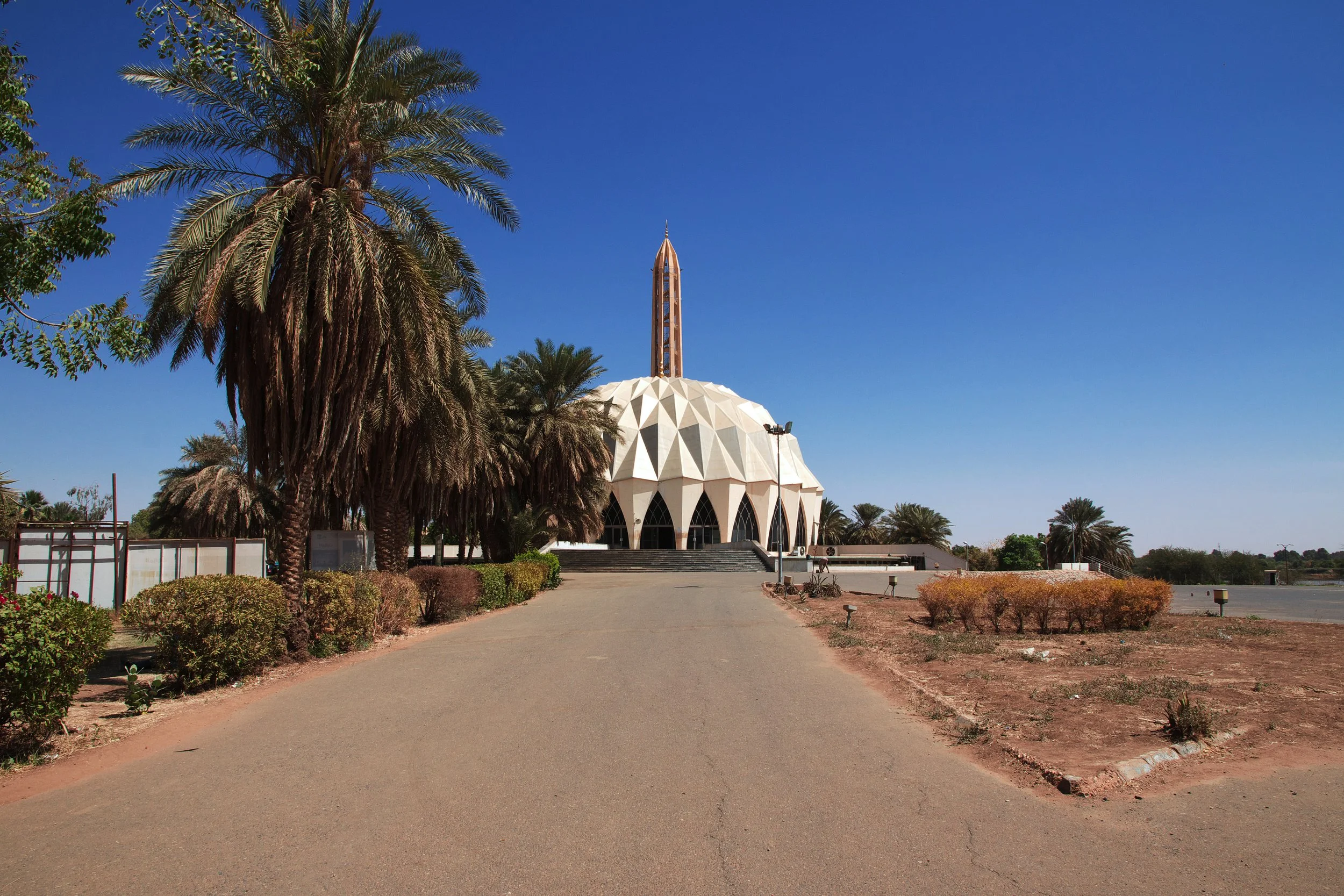
Masjid Al-Nilin, whose name translates as the Mosque of the Two Niles, stands on the western bank of the Nile at Al-Muqrin, the point where the White Nile and Blue Nile converge in Omdurman, Sudan. Completed in 1984, the mosque is unlike anything else in Sudanese Islamic architecture: a circular structure covered by a hemispherical aluminum dome, with no internal columns, the roof descending directly to the ground in the form of a giant shell. It was designed not by an established architect but by a student, Gamar Eldowla Abdelgadir, as a graduation thesis at the University of Khartoum's Faculty of Engineering and Architecture. When President Jaafar Nimeiry saw the design at an engineering conference in 1974, he ordered it built. The mosque that resulted became the first building in Sudan constructed from aluminum without load-bearing columns, and it remains one of the most structurally distinctive mosques on the African continent.
Who Commissioned Al-Nilin Mosque and Why?
The mosque's origin sits at an unusual intersection of student ambition and state patronage. Abdelgadir presented his design at Sudan's first engineering conference in 1974, during a period when Nimeiry's government was investing heavily in infrastructure and development projects, positioning Sudan as what his administration called the "breadbasket of the Arab world." The design caught the president's attention, and he directed that it be realized in Omdurman, which Nimeiry designated as Sudan's national capital, the historic city that had served as the seat of the Mahdist state in the late 19th century and retained its symbolic weight in Sudanese national identity.
The site chosen was deliberate. Al-Muqrin, where the two Nile rivers meet, is one of the most geographically significant points in Sudan. Situating the mosque there claimed that meaning: the building would mark the confluence not with a modest neighborhood mosque but with a landmark structure visible from across the water. The People's Assembly, Sudan's legislative body, stood adjacent to the proposed site, embedding the mosque within the apparatus of national governance.
Construction was completed and the mosque inaugurated on September 28, 1984, corresponding to 3 Muharram 1405 AH. By that date, Sudan's political context had shifted substantially. Nimeiry had imposed sharia law across the country in September 1983, declared a state of emergency in 1984, and would be overthrown in a popular uprising in 1985. The mosque that opened as a symbol of Sudanese modernity did so during the regime's most repressive phase. Nimeiry himself was exiled less than a year later. The building outlasted its patron's vision by decades.
What Makes Al-Nilin Mosque's Architecture Distinctive?
The mosque's defining structural feature is its space frame (a three-dimensional structural grid of interconnected aluminum struts that spans a large area without internal columns) configured as a hemispherical dome 30 meters in diameter. This approach was unprecedented in Sudanese mosque construction. Where traditional mosque domes rely on masonry walls, squinches, or pendentives to transfer load from the circular dome to a square base, Al-Nilin's aluminum space frame sits on a circular plan and carries its own load outward to the perimeter, allowing the interior to remain entirely free of supports.
The result, spatially, is a column-free prayer hall beneath a continuous curved ceiling, a rare quality in mosques of any period. Worshippers can gather without their sightlines interrupted by piers or columns, and the qibla wall (the wall facing Mecca, toward which Muslims pray) faces west, across the White Nile toward the Saudi Arabian peninsula. The orientation means the mosque faces the water, reinforcing the sense of a building in dialogue with its riverine site.
The interior surfaces are decorated with geometric timber ceilings and carved plasterwork. Decorations in the dome and mihrab (the prayer niche marking the direction of Mecca) were executed by artisans from Morocco and Sudan working in plaster and mosaic. The mihrab's minbar (pulpit) is described in available records as finely crafted. A separate pointed minaret rises beside the main structure without being integrated into the dome form, maintaining the traditional visual language of the mosque type while the dome itself breaks from it.
How Does the Mosque Complex Extend Beyond the Prayer Hall?
Twelve octagonal pavilions surround the main prayer space, each functioning as a distinct ancillary structure. Together they house a school, a library, and exhibition space. This pattern of educational and community provision reflects the traditional Islamic understanding of the mosque as a center of learning and social life, not only a place of congregational prayer.
The pavilion arrangement creates a spatial transition between the public waterfront setting and the enclosed prayer hall. Visitors moving from the Nile embankment through the pavilion ring to the main dome experience a gradual shift from open landscape to defined community space to sacred interior. This sequence, from the convergence of two rivers outward to a ring of community buildings inward to a column-free prayer hall, gives the complex a coherence that the individual structures alone do not convey.
How Does Al-Nilin Reflect 20th-Century African Mosque Design?
Al-Nilin belongs to a specific moment in post-colonial Islamic architecture: the 1960s and 1970s, when newly independent Muslim-majority nations across Africa and Asia were building mosques that drew on modern engineering rather than on inherited Ottoman, Mughal, or regional vernacular forms. This was not simple imitation of Western modernism. Architects and students trained in engineering programs across the Muslim world were asking what materials and structural systems available to them could achieve within the spatial requirements of Islamic worship.
Abdelgadir's aluminum space frame addresses a real functional problem: how to cover a large gathering space without columns, using a material suited to Sudan's climate and available through industrial supply chains rather than local quarries. The solution is neither Sudanese vernacular nor European transplant but a considered application of mid-century structural engineering to a specifically Islamic spatial program. In this it resembles contemporaneous mosque projects elsewhere on the continent: designs that sought formal distinctiveness not through historical reference but through structural honesty.
The building's recognition by the Aga Khan Trust for Culture and its documentation by the IRCICA (the Research Centre for Islamic History, Art and Culture) reflect its standing as a notable contribution to 20th-century Islamic architecture, one that has received less scholarly attention than its structural and spatial qualities merit.
What Is Al-Nilin Mosque's Current Status?
Al-Nilin Mosque's current condition is not possible to verify. Since April 2023, Omdurman has been a frontline in Sudan's ongoing civil war between the Sudanese Armed Forces (SAF) and the Rapid Support Forces (RSF). The city experienced sustained urban combat, shelling, and aerial bombardment for nearly two years before the SAF recaptured it in early 2025. Across Sudan, the conflict has damaged or destroyed an estimated 79 percent of mosques, alongside museums, universities, libraries, and centuries of accumulated cultural heritage.
Whether Al-Nilin is intact, damaged, or destroyed is unknown. No documentation of the mosque's specific status has been published in available sources. The absence of photographs from the war years is itself a consequence of the conflict: Omdurman was inaccessible to independent journalists and photographers for most of the period between 2023 and 2025, and documentation of heritage sites in the city was not possible. This post relies on pre-war sources.
What can be said with certainty is that a building whose structural system was unprecedented in Sudan, whose design traveled from a student's graduation project to presidential commission to constructed landmark, and whose site at the confluence of two rivers gave it a significance beyond its walls, now exists in a city that has suffered catastrophic destruction. Its future, like Sudan's, remains uncertain.
Glossary:
Space frame: A three-dimensional structural grid of interconnected struts that spans large areas without internal columns
Qibla: The direction of prayer toward the Kaaba in Mecca
Mihrab: The niche in the qibla wall indicating the direction of prayer
Minbar: The pulpit from which the imam delivers the Friday sermon
Squinch: An arch or bracket built across the corner of a square room to support a dome above
Want more Islamic architecture insights delivered to your inbox?
We publish a weekly newsletter exploring the design systems, building traditions, and historical stories behind mosques across the Islamic world. Recent posts covered passive cooling strategies, spiral minarets as political symbols, and the intersection of heritage and occupation.Subscribe here — it's completely free.